
aphorisms on Freya Thomas Taylor’s
Rage Milk
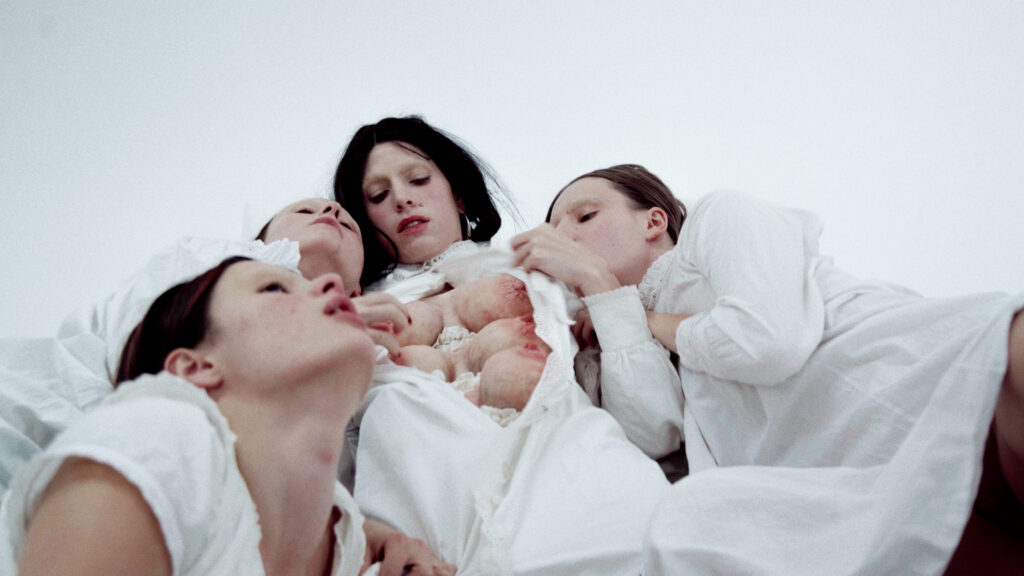
This text is not a review but an aphoristic response to Freya Thomas Taylor’s Rage Milk. Fragments of thought shift like perspectives around the installation. The poetic nature of the text resists a fixed interpretation; instead, it lets words linger, allowing meaning to unfold. The distance a critic typically assumes from the artwork — and from the language used to describe it — is closed. In its place, the I emerges, the body situated in dialogue with what it observes. As the philosopher Hans-Georg Gadamer reminds us, the artwork is not merely an object; it is an event. Meaning arises in the encounter, in the relational space between work and spectator. Each encounter is historically conditioned, fusing the world of the artwork with the spectator’s own situatedness in time and space. My reading of Rage Milk is informed by feminist art history. The perspectives I take reflect those historically taken on women.
on the floor
surrounded by white embroidered drapery,
we see the replica of a belly.
its beautiful curve and its pronounced linea nigra
mark it, as the belly of an expectant mother.
it is very lifelike,
this actually lifeless form.
forming a symbol
the expectation of life
                                     the life it carries is an abstraction
                                     as much abstract, as the
                                     body, to whom this extracted part belongs.
                                     to whom, in turn, does this body belong
                                     the bodies of mothers?