
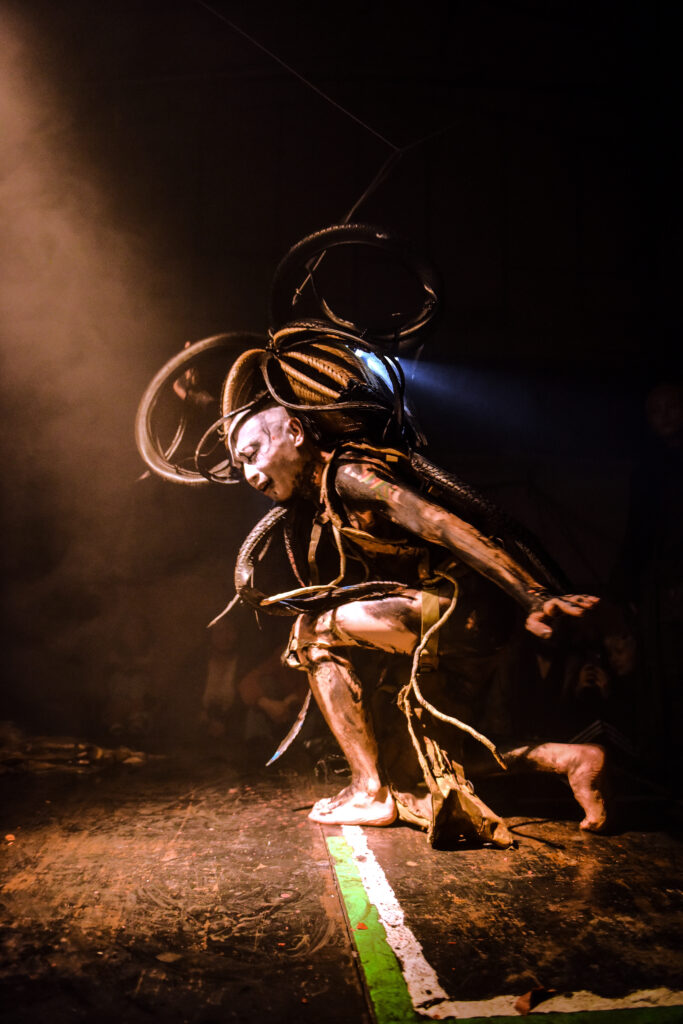
Yihao performing ‘Higher, Faster, Stronger’ at Opsis
The virtual realm has long been a sanctuary for queer self-expression, a place to slip effortlessly into new digital skins. But as safe spaces come under threat in the physical world, the need to bring those avatars offline becomes urgent. Moving Discourse is delighted to present Opsis: Taking the Glitch Away From Keyboard, a thoughtful exploration of this tension by writer and founder of Hyfae Magazine, Lily Bonesso. Articulating how digital fantasies can be encountered in physical space, embodied through movement, and activated as a stage for resistance, Bonesso draws on Legacy Russell’s ‘Glitch Feminism’ to trace how curators Ocean Dobree and Jessye Curtis have developed Opsis – a programme serving as a rare container for queer imagination.
“We are bringing the ‘glitch’ AFK (Away From Keyboard). We are bringing the error into the room.” – Legacy Russell ‘Glitch Feminism’
On the edge of an industrial estate, beside the busy Surrey Canal Road, Avalon Cafe is a blip on the edge of New Cross. Out there on its own, it’s concrete shell feels like a suitable subject for a George Shaw painting; ideally viewed against the rain-soaked pavement. It’s here that OPSIS (ὄψις), ancient Greek for appearance, sight, or view, has planted its flag. Founded as a dedicated programme for experimental movement by Ocean Dobree and Jessye Curtis, OPSIS creates a testing ground for artists to share work that’s still wet from the birthing process.
While it’s easy finding images of alien-esque queer avatars, trans angels, drag queens and lesbian power couples online, these people are often on the DL when out on the streets. Even in a city as open as London, queerness still needs safe spaces to self-express IRL – an idea Legacy Russell explores in her 2020 text ‘Glitch Feminism’. Russell argues that the “glitch” – technically an error in a machine’s system – is actually a form of resistance. For marginalised bodies, refusing to be “readable” or to function as society expects is a source of power. Russell argues for the necessity of bringing that glitch AFK (Away From Keyboard).
It raises a question at the heart of OPSIS: What happens when the avatar enters the room? Performance is the ultimate act of vulnerability because the artist literally becomes their art. OPSIS is about creating the freedom to perform that self.
To hold space for that vulnerability, you need a specific kind of container. The night feels less like a traditional showcase and more like a resurrection of the ‘Happening’. In his 1966 guide How to Make a Happening, artist Allan Kaprow laid out a crucial rule: “The line between art and life should be kept as fluid as possible.” He urged artists to reject the polished separation of the theatre and instead embrace the rough, the ready, and the real. A Happening is an event where the line between viewer and art is dissolved; a situation to be lived rather than an object to be viewed. OPSIS channels this energy, acting as a laboratory where the “glitch” becomes flesh.
Nothing captured this shift from digital to physical more than ‘Tethered Feedback’ by Ocean & Zhuyang. In a world where we are increasingly disconnected, their work forced a re-orientation of intimacy, yet ironically, that intimacy is facilitated through tech. The audience was held in total darkness, the performance lit only by the staccato flash of Eve Chen’s camera, documenting the show. Forms of closeness and separation emerge as carved out single-frame exposures – a guitar suspended mid-air, a mess of wires, a leather jacket rigged with sewn-in speakers. Connected by two guitars, the performer’s aesthetic was pure cyberpunk – two bodies converging and pulling apart in the dark.
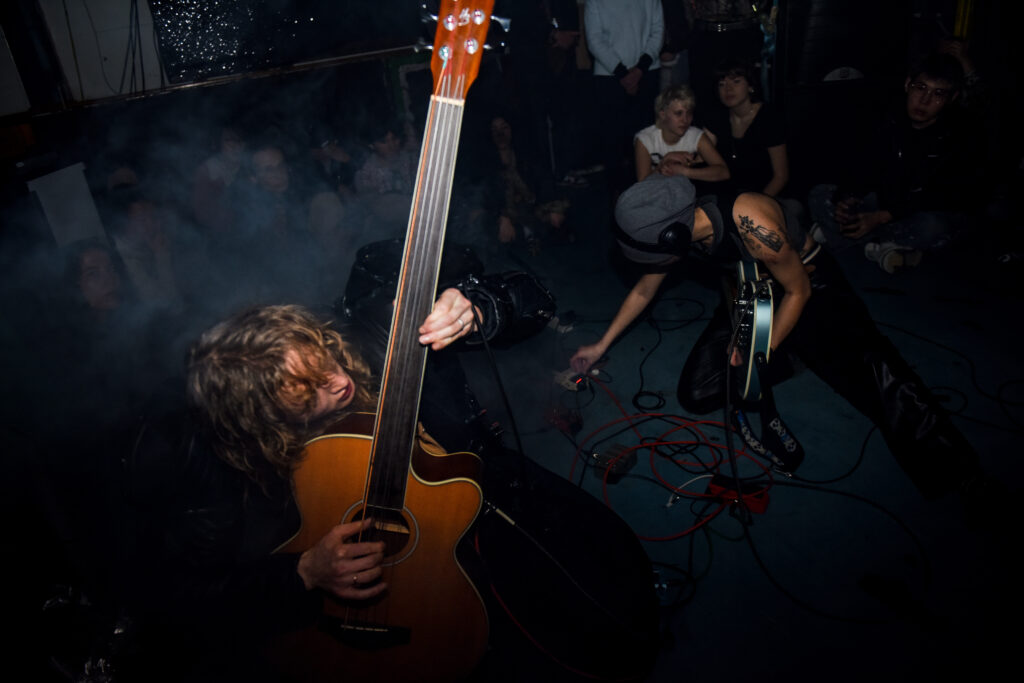
Ocean & Zhuyang performing ‘Tethered Feedback’ at Opsis
Ocean told me later that the audio is entirely improvised – it’s happening live. Using wearable sonic devices, the performers become instruments, a feedback loop created by their proximity to one another. It was like witnessing a cyborg rock concert. The perfect embodiment of Russell’s theory: a “refusal to be readable,” they created a language that was all sensory.
But if technology offers one escape route, the grotesque offers another. Throughout the OPSIS programme, I get the sense that to find our “real” selves, we sometimes have to become monsters.
My take on it isn’t coincidental. The curation is clearly influenced by Ocean’s thesis, Beautiful Monsters, which investigates “queer post-human dreaming”. Ocean writes that, since the very definition of “human” has historically been used to exclude queer and trans people, we can find hope by looking beyond it. Whether through the machine (the cyborg) or the monster, embracing this “post-human” state allows us to imagine a future where we’re free.
Yihao’s piece, ‘Higher, Faster, Stronger’, leaned heavily into this uncomfortable metamorphosis. He appeared as a giant bug-like creature, transforming the stage into a site of mutation. The performance was chaotic. After a jarringly sexual sequence involving a lot of water, he swung wildly from a wire, quite literally nearly pulling down the lighting rig, before crawling and rolling through the crowd.
Yihao uses the language of drag to critique the 2010 Shanghai Expo’s slogan “Better City, Better Life.” The drag queen’s plastic wig becomes a commentary: that we are all just parading through life in synthetic fibres, pretending that artificiality is progress. But does covering ourselves and our cities in plastic actually make for a ‘better life’? In the safety of the OPSIS underground, the queer body reflects the absurdity of the world back at us.
Beyond the monsters and the machines, the night serves a simpler purpose. It brings people together in a room to deal with all the mess outside. OPSIS is distinctly unpretentious. Since half the room seems to know the other half, the barrier between performer and audience is already thin, creating this feeling of safety that allows us to go to a more fragile place.
From Camille Boukobza’s (aka. Lily McMenamy) winesoaked crescendo, to Petrichor & Flowfinch’s office-core styling and rolls of printer paper, the more mundane the props, the better. It’s all very Kaprow. Tough Boys whipped up a storm with ‘God is a Taxi Driver’ using just a torch and some gaffer tape. Their bodies, oscillating between dog-like submission and rigid stiffness, trembled as if absorbing the frantic energy of the city itself. Their movements formed a code of repeated sequences that became a sort of full body sign language, before collapsing to the floor, whispering into a microphone as the music swirled around us.

Tough Boys performing God is a Taxi Driver at Opsis
The climax felt like a hallucination. Using the strobe setting on the torch, they created the sensation of being inside a storm. It became a bouncing fight, or maybe a dance, where one person kept falling and the other caught them. By the time it ended, with one of them dancing another repeated sequence, but this time sensual, expansive… the whole room felt like it was vibrating with them.
Leaving Avalon, you get the sense that you haven’t just watched a show, but survived something together. These artists are testing out fantasies, purging anxieties, and building new realities. By celebrating these ‘glitches’ – the cyborg, the bug, the siren, the creature – OPSIS is building a queer utopia that refuses to be readable. It reminds you that performance is at its best when it’s risky, intimate, and just a few centimetres from your face.
References