The phenomenology of trans-masculine gender flux in performance
In a political climate that demonises and pathologises trans realities, this insightful text by performative researcher Kars Dodds is both an intimate documentation of their own being in flux and a political call to action. Responding to the persistent absence of trans-led inquiry within academic discourse, Dodds’ embodied, phenomenologically centred methodology not only addresses significant epistemological gaps but, through the positioning of the Self as both subject and object of research, simultaneously enacts a political gesture of queering and destabilising the epistemic rigidity of academia itself. This writing — and Dodds’ artistic practice more broadly — is situated within the context of queer theorists such as Sara Ahmed, T.J. Bacon, and Susan Kozel, and is influenced by queer artists such as Wet Mess and Cassils. Yet, while this text engages with those queer voices, its sensitive tracing of trans-masculine corporeality allows it to become something of its own.
Author’s note: This piece was completed in September 2024 and addresses the social climate facing the trans community up until that point in time. With the current risk of segregation as a measure to remove trans people from public life, the gender flux I describe has become an even greater risk in the past year. The core of my work lies in a yearning for freedom of expression for all. None of us are free until all of us are free. Free Palestine. Free Sudan. Free Congo.
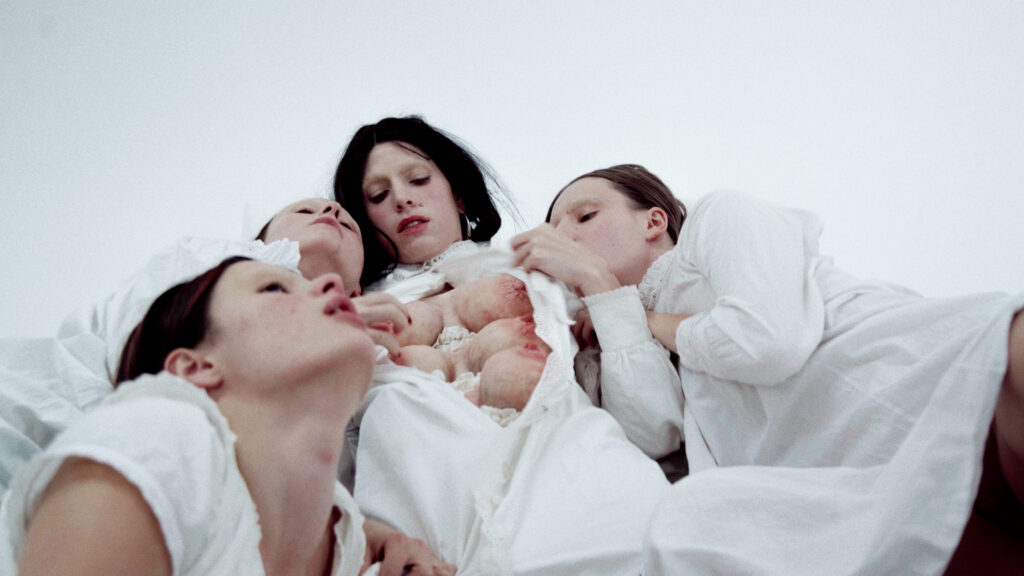
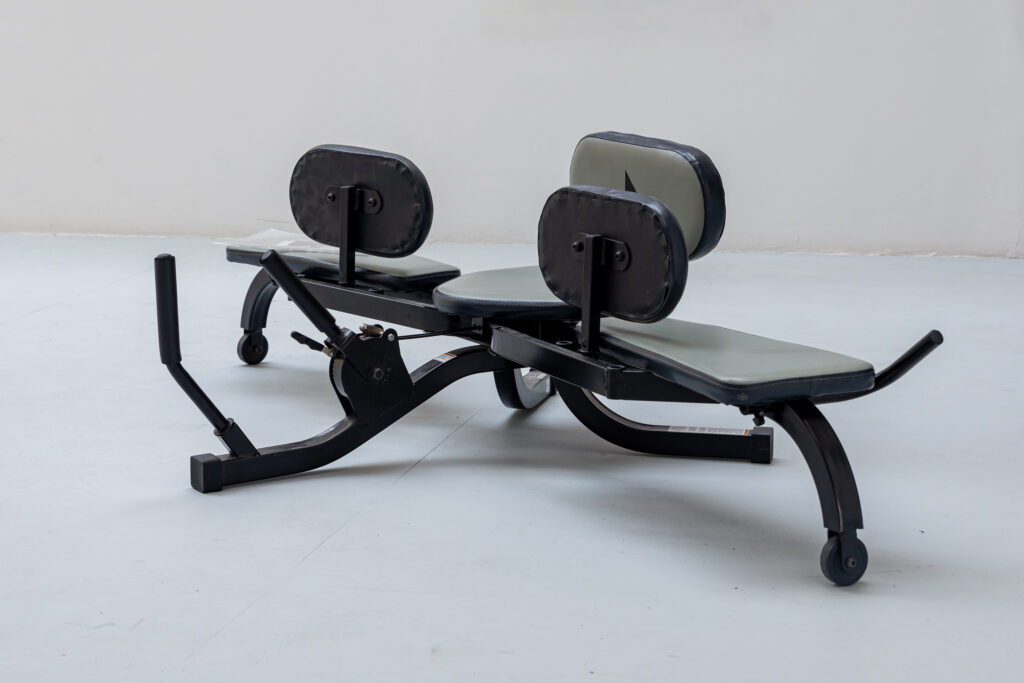
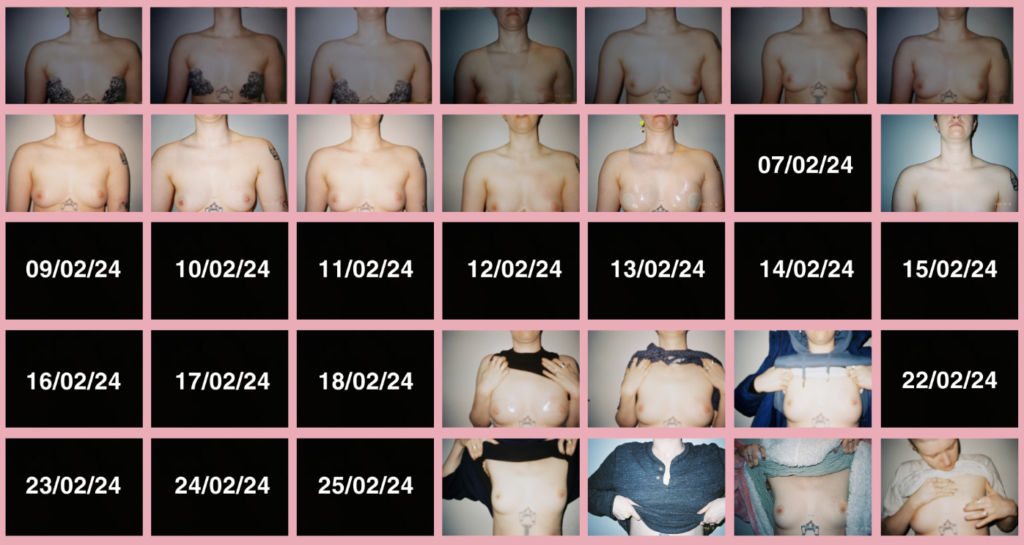
This piece is a protest of trans visibility by documenting and discussing my experience of ‘having tits’ as a trans-masculine person. This text is built on the research for my work Trans-masc Tits: WHY NOT CHOP THEM OFF which confronts readers, viewers, and myself with the aggressive realities of gender dysphoria, specifically chest dysphoria as experienced by individuals assigned female at birth (AFAB), while also allowing for ambiguity and the irreverent pleasure of being trans. The phrase WHY NOT CHOP THEM OFF originates from my practice, the ambiguity and potential for misinterpretation of which are deliberately employed as a provocation. Being trans is not a pathology, and there are many pleasures to this semi-dissociated relationship I have with my tits. The joy of being this way is that there is no given way to be. There is space and endless permission to fail my undefined gender joyfully. While undergoing periods of gender questioning, there is a gender ambiguity that offers an abundance of possibilities to the individual. In itself, being trans provides a natural liberation from gendered social expectations. The continual questioning and discovery have given me the most immense joy and pride in myself and being trans.
It is my hope, first, to provide an example of raw trans visibility for anyone who is questioning their gender identity and finds themselves confronted by transphobic attitudes and institutions. Secondly, I hope to provide a reference and example of in-betweenness in the transition process for artistic and academic discourses, where binary gender is dominant.
Beyond my interests, this writing — along with my ongoing performative exploration of the topic — counters current Gender Critical discourses across academia and socio-political dialogue. My motivations for this research are personal, where I firmly believe that the personal is political. I attest to the challenges my identity, body, needs, desires, and those of those within my community face.
Positioning the Self: On Motivation and Method
On a broader scale, transgender visibility is increasingly essential as anti-trans legislation, institutional transphobia, and Right-Wing ideologies continue to chase us with metaphorical torches and pitchforks. Trans people, and our allies, are tasked with amplifying our voices for our right to healthcare, safety, recognition and unadulterated, messy, loud, colourful, authentic queer joy — none of which we take for granted. Historically, queer resilience, protest, and community have been our primary tools for survival towards the visibility we have today. Current matters show that while we are more visible than ever, we still bear the weight of excessive discrimination. The United Kingdom has witnessed rampant and unfiltered transphobia across the lead-up and aftermath of the 2024 General Election. Trans kids, young people, and adults have been mocked and used as political pawns, for example, in the public and political coverage of the transphobic murder of teenager Briana Ghey. Rishi Sunak openly mocked trans-womanhood while the teenager’s bereaved mother sat in chambers. Keir Starmer, in retort, publicly shamed the then Prime Minister (Courea, 2024), an act of allyship he is yet to remain firm on post-election.
The vicious acts of transphobia, gender critical discourse, and conservative politics that mock and dehumanise trans people make being transgender in this environment a deeply challenging experience.
In a societally hostile environment, where possibilities for identification are limited or absent, queer people are compelled to cultivate resilience and the strength to orient and locate themselves within an unwelcoming society.
This often exhausting process of seeking orientation is examined by queer theorist Sara Ahmed, who, in Queer Phenomenology, introduces the concepts of orientation and disorientation. By doing so, she demonstrates that queer people are tasked with finding themselves constantly without the privilege of seeing themselves within the world (2006, p. 12). It goes without saying that in many communities and for many people, this results in denial and shame of the authentic experiences of the Self, or rather Self/s which I later explain. This highlights a social determinist frame through which queer visibility and resilience are limited, varying from individual to individual.
I encountered significant challenges navigating a binary-conceptualised world throughout my career as a professional dancer, especially within the rigidly gendered structures of the ballet world. While training and performing in ballet and contemporary dance styles at a professional level, I experienced more than ten years of gender questioning.
My first notable experience of gender dysphoria took place while preparing for a run of The Nutcracker (an annual ballet tradition). I could not recognise myself in the mirror as I painted my face and strapped myself into a tutu in the dressing room. This incongruence continued to fluctuate and peak over the next 3 years. I then came out as non-binary and started to decrease my commitment to technical dance training. I lived proudly under these terms until moments of masculine certainty became recurrent in 2021. These experiences and an ongoing incongruence with my trained artistic medium led me here, where the overlapping incongruence between my gender identity, embodied experience, and trained performance practice requires my attention towards reclamation.
Inspiration for reclaiming my artistic practice came from queer artists whose work exists beyond traditional canonical frameworks in dance, sculpture and performance art. One of those artists is Katy Pyle, who is the founder and director of Ballez, a queer New York City-based ballet company. With their company of queer and trans dancers Pyle has created a place for queer stories and bodies within the canon of story ballets and the ballet class framework. In their forward to (Re:)Claiming Ballet (2021) Pyle discusses the importance of reclamation from the traditions of ballet that made them betray themselves. They write “This applies to technical standards as much as dress code and classroom decorum. And we carry this lineage in our bodies right alongside our technique. These deeply internalised value systems do not just damage us, they also isolate and fractionalise us away from one another” (2021, Pyle). Similarly to Pyle, I easily lost my authentic sense of Self in the traditions and normative patterns that ballet drilled into my body. The eroded Self that remains, I perceive as being in a transitory place that fluctuates from affirmation, and dysphoria, and results in a messy, complex gender experience. In my current separation from ballet and dance performance, I am reclaiming both my Self and my artistry. Pyle has found a reclamation in redefining the norms of ballet, while I seek reclamation by expanding the mediums through which I create to make sense of my gender identity through bodily and material explorations. This expansion is like stretching the concept of the self, allowing fluidity and plurality to emerge.
The fluidity of Self/s that inhabits the gender-diverse individual throughout their lifecycle and the orientations they navigate socially and somatically, generates a multiplicity of opportunities for orientation. Normative notions of the biological body, gender, identity, and sense of Self are all opportunities for orientation or disorientation in contextualising ourselves and our experiences. Orientation towards the body as a place for making sense of things, for me, is occasionally disorienting due to the unpredictability of my gender dysphoria. The centrality of my tits within my dysphoric experience ironically informs my identity as a way of orienting me socially and internally as a trans-masculine person.
On tits.
In the title of this work, I intend for ‘tits’ and ‘chop’ to stand out as colloquial expressions to disrupt formal academic linguistics and in an effort to reclaim them against my chest dysphoria. While each reader will hold different associations and reactions to the word ‘tits’, I chose to use it in protest and for the reclamation of my own body. ‘Tits’ holds a negative, patriarchal connotation that sexualises and objectify cis-women, trans-feminine people, and trans-masculine people with tits. As part of my research I explore the historical etymologies of the Oxford Dictionary and my trans-ed relationship to ‘tits’ and ‘chop’ to define my use, and relationship to the words themselves.
‘Tit/tits’ are now most typically used as slang to indicate a person’s breasts (Oxford English Dictionary, 2024). As an object, ‘tits’ then become a source of sexual desire and degradation. The original use of ‘tits’comes from Old English (5th century to 1066) to refer to the teat or nipple (Oxford English Dictionary, 2024). This first use of tit/tits references both human and animal bodies, suggesting a dehumanisation that likens women’s bodies to milk production in livestock, assigning a capitalistic market value in alignment with the body part. In later uses, ‘tits’turn almost exclusively to the bodies of women/AFAB individuals when implying sexualisation or sexual attraction. Since 1881, ‘tit’ has been used as an insult, meaning ‘idiot or fool’ (Oxford English Dictionary, 2024). This meaning degrades the individual to establish a hierarchy of worth and power between the insulter and the insulted by othering the insulted. By choosing to use this word of dense weight and history, I feel I am able to reclaim the sexuality, gender, and objectivity of my body. Descriptively chop is satisfyingly aggressive and definitive. To chop is defined as “transitive; to cut with a quick and heavy blow; now always with a hewing, hacking instrument, as an axe or cleaver; formerly also with a sword” (Oxford English Dictionary, 2024). The use of the word is productively destructive, in the same way that top surgery is to someone with chest dysphoria. Simple, only one sharp movement and done. As a noun, ‘chop’ refers to a type of meat, generally a rib (Oxford English Dictionary, 2024). Meat comes from an animal that is, or once was, alive. The act of chopping separates the object of material value from its aliveness to serve another purpose. In this sense, I could consider my tits already chopped. They may be mine in their attachment to my body. Yet I frequently experience them as disjointed, separate from myself. As a trigger to my dysphoria, they are perceptively other, in a denial of somatic attention. I bind them with tape or cover them with layers of clothing. And I pull, poke, and prod at them. In this, there is an in-betweenness of dysphoria and euphoria, and ownership and dis-ownership – where I can happily act on them as an object. Undoubtedly, I want to chop them off, to disown them and find myself imagining my body, myself, and a life without them. Me and my tits, somehow connected in flesh but disconnected in Self. I discover safety in self-objectifying my tits, as it affirms them as an object. It is as if I can reclaim my ownership of my body and identity, and of my tits, by rationalising them as an external object.
Fuck the ‘stages of transition’
The trans-masculine frames my inquiry into the lived experience of ‘having tits’ to infer that, as a trans-masculine person, my tits are a significant trigger to my gender dysphoria, causing me to experience chest dysphoria. Gender dysphoria is defined as “when a person experiences discomfort or distress because there is a mismatch between their sex assigned at birth and their gender identity” (“Glossary – TransActual”, 2024). Additionally, gender dysphoria is a clinical diagnosis that is compulsory for gender-affirming surgery referral in the UK. For trans-masc people, this commonly includes a subcutaneous mastectomy, or colloquially ‘top surgery’. A common experience when coming out is that the surgical status of the individual’s anatomy becomes the first object of interest to the other party. Shon Faye and Travis Alabanza cite this experience in their respective works, The Transgender Issue (2022, p. 64) and None of the Above (2023, p. 41). In the UK, the National Health Service (NHS) allows self and GP referral to Gender Identity Clinics (GIC), where waiting lists are notoriously long. This creates a significant barrier for trans people, as there is an elusive and undefined waiting period (Zaccaro & Fagg, 2024). In protest, a group of trans youth from the UK-wide action network Trans Kids Deserve Better scaled to the ledge of the NHS offices in London Waterloo to protest the NHS-commission Cass Report that led to the nationwide defunding of puberty blocker for trans people under 18 (Stonewall, 2024). They camped out there for 4 days. One activist, Deb (17), mentioned their mantra while camped out on the ledge, “it’s safer up here than on the NHS waiting list” (Baker, 2024). Deb’s words are visceral and capture the mental state of trans people across the UK, myself included.
The stages of gender transition, as they are understood and most commonly communicated, are incomprehensive and oversimplified categories that suggest an unrealistic linearity. The stages include self-discovery, social transition, and medical transition. This provides a linear timeline for gender discovery that is unattainable, if not impossible, for non-binary-leaning trans people. In 2023, an Interpretative Phenomenological Analysis (IPA) study on the trans-masculine experience of care in GICs showed that the medically accepted ‘stages of transition’ were commonly rejected by participants as a way of gatekeeping affirming medical intervention. Instead, participants were tasked with fitting their experiences into these stages to make them ‘convincing’ enough to receive medical attention (Mills et al., 2023, p.21). Fluidity, non-linearity, and flexibility within the gender binary and approach to transition were outside of the medical understanding of transness as a pathology. Mills et al. show that this rigid approach to transition was not recognised by anyone within their pool of participants (between the ages of 23-44) as they discussed coming out and discovery as a ‘life-long’ process, not a mere ‘first stage’.
In my work, I am curious to investigate the decision-making process and waiting period between social and medical transitions. ‘Social transition’ defines the period in which an individual makes social changes to align their social experience to their gender identity, e.g. using a new set of pronouns, a new name, or changing their appearance (TransActual, 2024). Frequently, in the common binary understanding of transness, this occurs before any medical intervention as a way of ‘trying on’ and ‘trying out’ new forms of gender expression. Though there has been a significant shift towards self-referral in gender-affirming care, you are required to have lived socially as your preferred gender for at least 2 years to get a gender dysphoria diagnosis and gender recognition certificate (GRC). The diagnosis is no longer required under the Equality Act 2010, which protects UK citizens from discrimination across all aspects of life. Still, a GRC makes the process of accessing referral to gender-affirming surgery smoother. The Labour Party has promised to review and make the process simpler. However, this announcement preceded Prime Minister Keir Starmer’s public agreement with J.K. Rowling, in an interview with The Times, said that trans women should not be allowed in ‘biological women’s spaces,’ referencing the ongoing transphobic argument that trans women are merely predatory men seeking access to women’s spaces (Swinford, 2024). The requirement for a diagnosis and GRC act as a way of gatekeeping gender-affirming care from trans people (Ashley, 2019, p. 480). As a prerequisite to affirmative care, it functionally prolongs consistent experiences of gender euphoria and delegitimises the person-first trans experience. It also means the individual must tackle the dangers of ‘not passing’ or being perceived as trans during this period. In 2020, an IPA research study examining gender dysphoria found that alongside experiencing dysphoria, research participants experienced both negative social consequences due to their gender identity and internal processing of rejection and transphobia (Cooper et al., 2020, p. 7). Thereby informing the complexity of the gender dysphoric and trans experience through internal and external perception(s).