
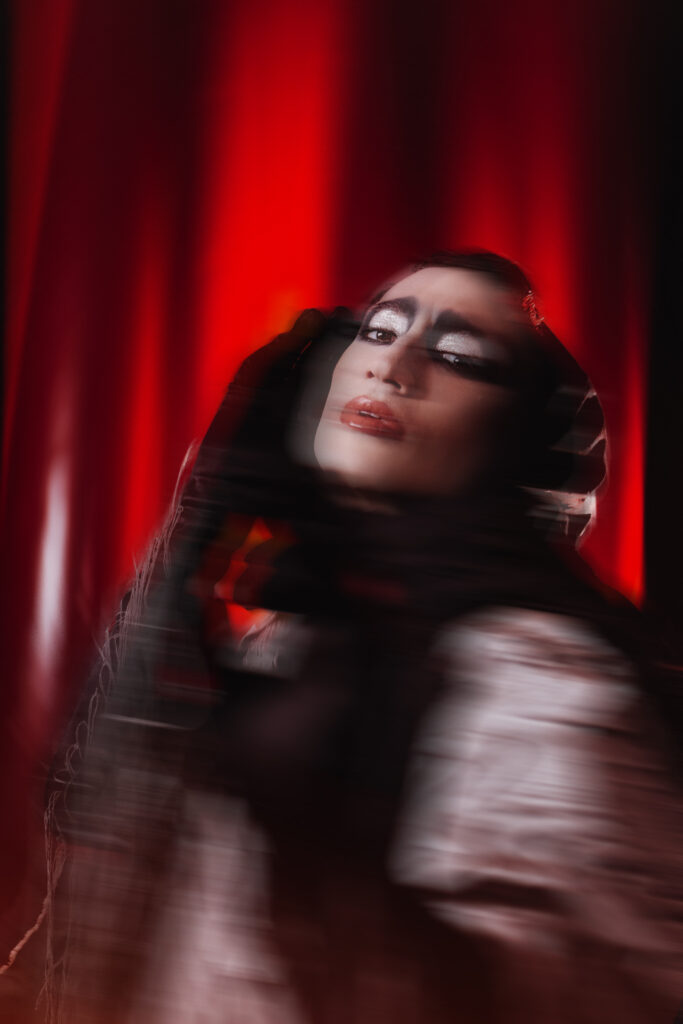
Are affects socially mediated, or are they, as philosopher Brian Massumi argues, autonomous — operating in the body before language? What about something in between: between raw expression and social codes? During the Enlightenment, when reason, individual liberty, and the organisation of society through rational principles were central concerns, Jean-Jacques Rousseau wrote The Social Contract (1762). Considering how individual freedom relates to collective norms, he proposed that society is formed by individuals who rationally agree to a social contract: an unspoken framework that shapes our interactions. While Rousseau thought of this contract as juridical and abstract, after the performative turn we might ask how such agreements are enacted in daily behaviour, and how, when the body and its expressions are socially coded, we can question, stretch, or transform the contract. The performer Bruno Brandolino reflects this in the most melodramatic way on stage, and in the most poetic way in his writing. Originally published in Portuguese as the programme note to his piece Melodrama: senza te, Moving Discourse is delighted to share its English translation here for the first time. Brandolino asks: can affects serve as the experiential counterpart to social pacts — allowing us to enact, challenge, and transgress them?
To introduce Melodrama: senza te is perhaps only possible by turning to what remains invisible. That which gives rise to the work, sustains it, and exists as its negative space — within both the piece and its process. Though never stated, and not conceived as a theme, this invisible dimension is a fundamental part of the shared event. It unfolds inherently, alongside and inextricably bound to what we are able to apprehend.
Within this negative space, I find, for instance, my own history of migration. To move away from a territory — from the places and affections that, for more than twenty years, shaped who I was and gave me contour — is to lose a framework through which I had been building, reading, and understanding myself. Once this framework of reference, belonging, and identification disappears, the figure is set against another background. One that no longer returns the same contrast, but a different, unfamiliar one. As a result, the perception of one’s own figure shifts. Its form is altered, and with it the account — the narration, the meaning — we make of our life and existence.
Thus, this becomes a process of negotiation — between what remains and what transforms, between what was once mine and what no longer is. In distinguishing what belongs to family, to the nation-state, to the city, or to friendships, what ultimately remains is the exercise of deep listening: listening to that which may correspond with me. And among what I heard, there was this melodrama.
This melodrama — this melodramatic affect, as I have called it — emerged in more solitary times to embrace me and to remind me of a particular pleasure: a familiar and delicious one, romantic and delirious, emotional and melancholic, playful and ironic. When it arrives and takes hold of the body, turning solitude into company and one into two, it becomes impossible to deny our bond. To transpose this affect from the intimacy of my home to the scenic space, and to make it an object of study and aesthetic experience, required tracing and examining where it comes from, and what this affectation is about.
It was not difficult to trace, for it was everywhere. I first encountered it at the age of twelve, when I began doing theatre in a small hall in downtown Montevideo — simply to be able to see my cousins at least once a week. That very reason already spoke of an affective, romantic impulse, and it led me — from total ignorance of theatrical art — to fall in love with that old, neglected room: the smell of dusty wood, the yellowed scripts of works far too grand for the mouths of children, and an underground wardrobe filled with costumes of questionable taste.
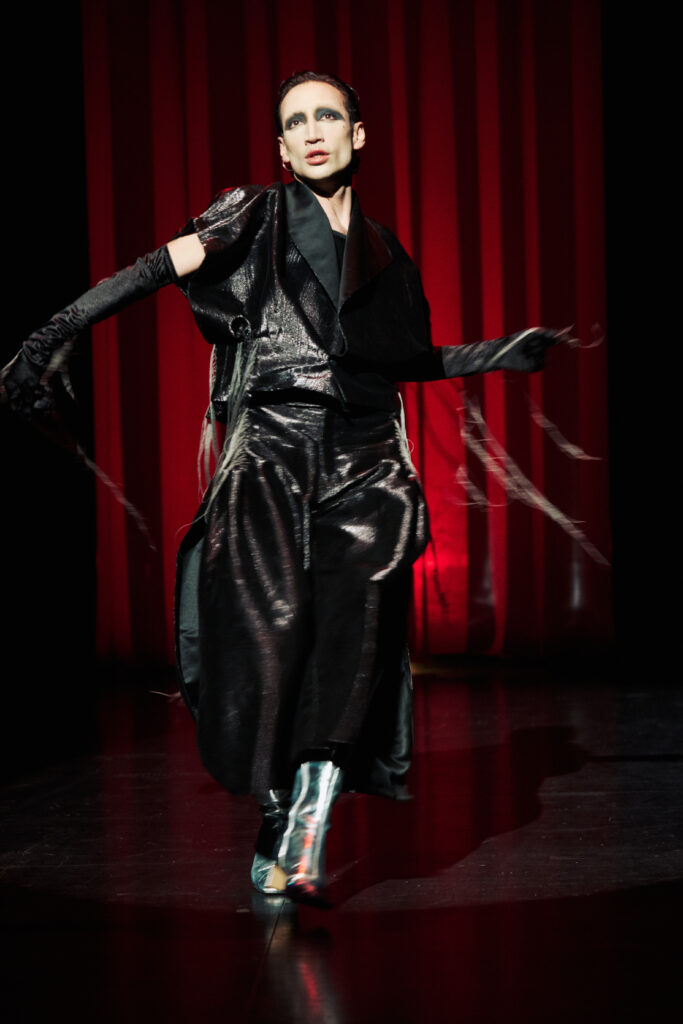
I also found this affect in my adolescent passions: a fascination with the performances of Bette Davis and Joan Crawford. Their excessive, somewhat ridiculous, yet supremely virtuosic modes made me want to be an actress — not an actor, always held hostage by the unbearable restraint of masculinity.
I was fascinated by the works of Copi, with their subversiveness, their political incorrectness, their — literally — (de)generated delirium. Almodóvar’s films, with their saturated colours and pop references, accompanied by boleros and romantic melodies. Fassbinder’s films, more serious, openly politicised and intersectional; and the monumental interpretations of vocalists such as Mina Mazzini, Rocío Jurado, Lola Flores, Juan Gabriel, and Isabel Pantoja.
I even recognised it in productions of my own at school, such as that somewhat costumbrista text entitled Lágrimas de Satén, which I wrote with my best friend, and in which we told the melancholy of a woman alone in her house.
Melodrama has always been there.
In any case, its principal source must be, above all, my own mother: the greatest reference for this passionate romanticism. Every morning she took her shower listening to the radio program Aquí está su disco, where listeners always requested the same infallible Latin and Hispanic romantic melodies. Upon entering the bathroom, I was simultaneously enveloped by the steam of hot water, the syrupy music, and the scent of her body cream.
But it wasn’t this melodramatic affect alone that I inherited from my mother. Unconsciously, she also taught me about performance — the performance of life, and that of the stage. With her impulsive, irreverent, and somewhat erratic character, she allowed me to see that the rules of normative sociability are nothing more than that: a pact, a performance. Unconventional as she was — a trait that extended to my entire family nucleus — she made this social pact evident. Over time, we understood that this was not a condemnation, but a virtue. A way of being that, although not free from sorrows, taught us about acceptance, humour, and, above all, a certain irreverence and distrust toward normativity and decorum. Because, after all, normativity is nothing more than a performance, well sustained by a large cast.
This influence, these teachings, shaped my understanding of fiction and performance. As in life, the stage is built upon pacts between those who watch and those who perform: pacts that can be sustained, broken, or transformed. Pacts we agree upon without words, and to which we commit ourselves the moment we enter a room. My desire is always to play within the visibility of these pacts — to assume them, traverse them, stretch their limits until they break, and then reconstruct them or build new ones. In this movement, we are transported to other realities: becoming unknown to one another, unfamiliar with language itself, left without tools to understand, decode, or interpret what we are living. The only possible path of reading is the sensorial — what happens in and between bodies. How fascinating this space of performance is, allowing us — even if only for a brief instant — to inhabit the collapse of meaning, the fall of referential frameworks, a true poetic revolution.
I can say, then, that these are the invisibles of Melodrama: senza te — the negative space of this fiction. A fiction constructed to share an emotional complexity that oscillates between serious melancholy and unabashed irony. To inhabit my intimate fantasy and extend it to you; to invite you to experience the construction, deconstruction, and reconstruction of these pacts. To lose ourselves in language, knowing that we travel together.
Author’s note: This text was written as a programme note for the performance’s presentation at Teatro do Bairro Alto (Lisbon, Portugal) and was made accessible to all spectators. Originally published in Portuguese, this English translation is published here for the first time on Moving Discourse.