
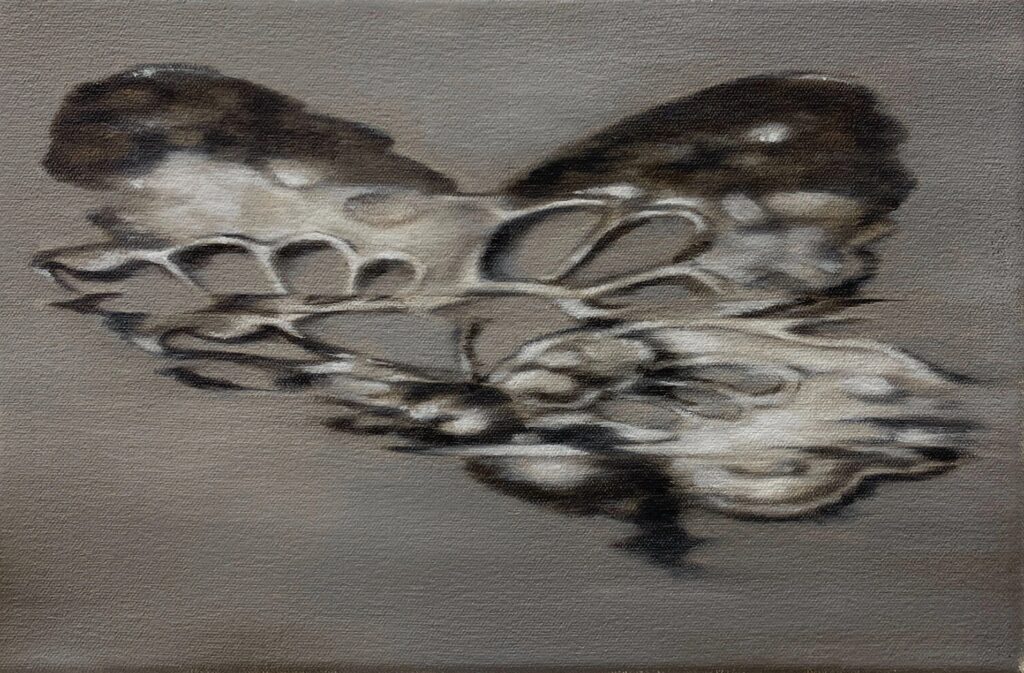
Utopias, like dreams, have the potential to transcend the present, allowing us to imagine alternative realities. A utopia can be understood as a collective or social dream, charged with a desire for systemic change. If we could not dream, we could not imagine things differently. Dreaming is a form of rehearsal for possibility — the emotional core of utopian thinking. On a collective level, societies rehearse utopias through literature and other forms of art. These works become pathways toward a different reality — or a momentary escape from the one we inhabit. To Desiring Elsewhere together, Moving Discourse invited Yvette Chan, winner of the Bloomsbury Fiction Mentorship Programme, to share the opening of her short story Nightrunner A dreamlike tale about chasing the moon, this brief excerpt reads like a shooting star — flashing across the sky.
I used to egg my father on to drive faster in the night. Not to feel the thrill of moving faster than humanly possible, or to hear the engine growl, inhabit something monstrous and disruptive. I asked my father to chase after the moon. He’d indulge, of course, revved the engine to overtake cars, and used the opportunity to teach me my bearings, distance, size, speed, perspective. My father also taught me about the ever changing moon, who was our guiding light as much as it was indecisive. Whose glow differs each night and phase, whose placement in our sky depends on the seasons and time. At the very least, the moon is chartable, predictable, which means we can always find our way back to it, and guess where it might go next.
My father would roll down the windows as the engines worked double-time, raise his voice slightly to prevent the wind from swallowing him, “See how fast we’re actually going? Feels different when the windows are up, right?” I would laugh as speed ruffles my hair and fills my lungs, but no matter how fast we went, the moon was always a stretch away. After five minutes of my shrieking in amusement, he’d slow the car back down and say, “Well buddy, we gave it a good go. I guess the moon’s too far away again, we can try again tomorrow. ” And this is how I learnt that when things are far away, you can choose to close the distance, and discover that the object of desire is bigger, more real, and its surface texture will not always be a stranger to your fingertips.
The moon and sun were the world’s first clocks by being expected at designated places at specific moments. So, like clockwork, I lace up my running shoes and am out of my building at 23:00. By 23:20, I cross paths with Caleb from down the street—a “pre-successful” photographer most busy with potty training the cat he’s fostering this month.
Caleb likes surprises and changes in his life. I don’t just mean his dedication to the new cat. He has a habit of changing routes mid-run to get lost in town, and keeps a small film camera in his belt bag in case inspiration strikes and has this habit of. Instead of feeling stranded, he’s more interested in seeing the new details in buildings and trees, he’ll climb hills and wade river streams to get the perfect shot. Then, he’d text me pictures of himself wandering suspect locations at night. I reply with a suggestion to run toward the moon when he’s lost his bearings, but he never does.
“I’ll manage”, he’d say, indulging in the turbulence despite how unpredictability clings. He was meant to have his first photography exhibition five months ago, but it’s been rescheduled twice now because time takes more than it gives. My shadow and silhouette are featured in several of Caleb’s photographs. At the end of the month, Caleb processes all his photos and shares them with me when we take a break. His pictures are quite good. Most of them are studies of contrast, an admiration of shadows and darkness of mundane things. There’s one where my silhouette is illuminated by the full moon, running away from the camera, my head very obviously tilted upwards as if in worship. Caleb says I run like that most of the time, and that he’d have to clap my shoulder to keep my eyes on my surroundings, as if I don’t know my running route with my eyes closed.
“The moon’s not going anywhere,” he says. “If you twist your ankle on uneven pavement, don’t say I didn’t warn you.”
The moon is always going somewhere I can’t follow. The calculated distance between myself and the moon doesn’t change so long as my feet are touching the Earth. That said, in every step forward something lovelier than delusion makes the moon appear to be closer, brighter.
“That’s called astigmatism, actually,” Caleb corrects. He’s wrong, though, because astigmatism can’t also be what makes shadows feel like the only subject he likes to capture on camera.
Caleb and I part halfway through our run, with him usually following where the moonlight doesn’t shine while I head for its source. Tonight though, Caleb is returning home early since the skies don’t look friendly as midnight approaches. The temperature drops until the warmth I’ve acquired from running has been taken by the wet and cold. The moon has been taken too. You can barely see her, she’s already so thin and trying her best to illuminate the clouds closest to her before she becomes just a smudge in the sky.
Without a guiding beacon, my engines slow to a stop. I pant with my hands on my knees while leaning against a street lamp in the residential area before the train tracks. It’s always quiet here. There are never more than five people on the street at this hour, and never less than one fox sighting a month. The street is lined with red brick houses, and every door is coated in a different coloured paint. The pavement has seen better days, with how many potholes there are, but the street across me has a wider pedestrian lane. Cars park beneath lit street lamps, yellow lights leaking through tree leaves, and the three-storey brick houses have close-blind windows where minimal light peaks through. Between two of the houses sits a newer, plainer, building. A two-storey modern building featuring a fluorescent white sign with words in red: “Corner Market & Diner.” It’s a loud invitation to go in.
The paper taped to the storefront window says they’re a 24-hour store and diner, except on Fridays. The bell twinkles when I enter. The fluorescent lighting paired with empty grey walls and floor is overwhelming for a second, and I blink away the brightness as I close the door behind me.
The storeowner by the cash register to my left looks to be in her fifties, in a loose dress the same colour as the store sign, a deep red accentuating her black hair. Meanwhile, I’m in my wet running clothes and windbreaker, dripping water into her shop.
“Dine in or shopping?” She cuts to the chase.
The space inside seems neither big enough for a market nor a diner, much less both combined. There are refrigerators for beverages, snack aisles, a section for miscellaneous household items, and an entire fresh produce aisle. The white of the floors, walls, and lighting accentuates all the colours in the store. Fresh green cucumbers, brown eggs, and ripe blueberries are a burst of vibrancy I didn’t expect at a corner shop.
“Where’s the dine-in?”
“Order here and sit down later,” She says. With her left index and middle finger, the storeowner pinches a flyer from a clear plastic stand. A gold ring sits on her wedding finger, decorated with a small red gem the same shade as her dress.
________________________________________________________________________
Text illustration
Artist: Jiaqi Lyu
Artwork Info
Tell Me about the Grassland, Will You? (heirloom jewelry passed down from my great grandmother)
○ 20*30cm
○ Oil on Canvas ○ 2025
● It is the only thing my great-grandmother passed down to me, a silver butterfly-shaped brooch, made by a silversmith in Jilin Province. She passed away before I was born. I know very little about her, only fragments of scattered memories. She was born on the edge of the Khorchin grasslands, and she died from a pneumonic infection.