
A conversation Between Dykes about performing gender at the gym
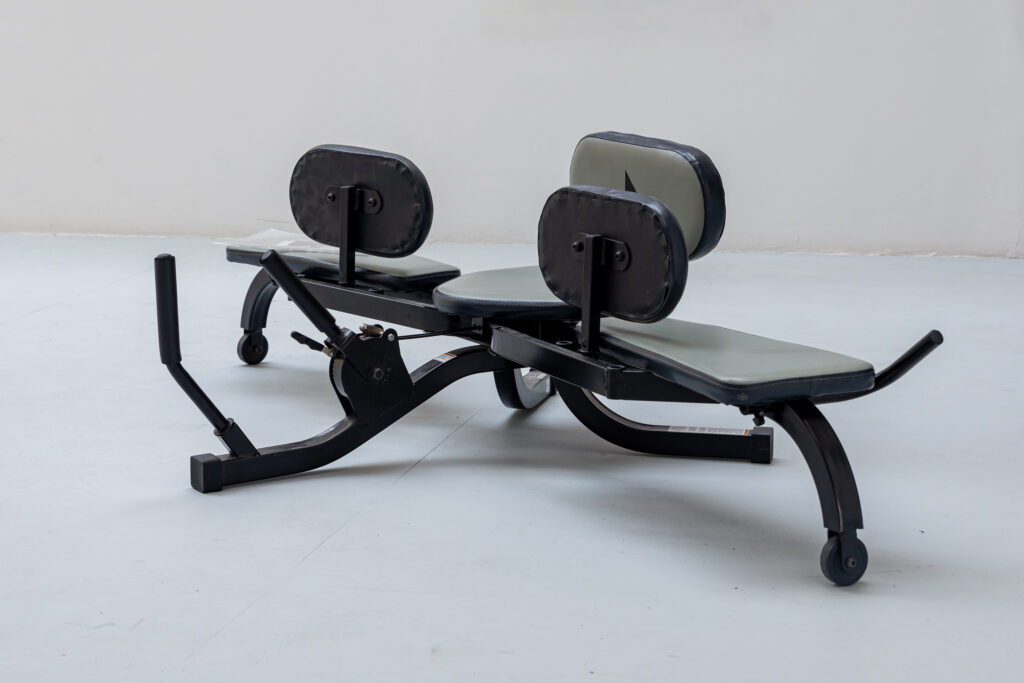
Max Petts, Century Versaflex; for Pantaloon, 2023 / © Gillies Adamson Semple / Further context on the artwork can be found at the bottom of the page
The following text is a transcript from the podcast Between Dykes. In their show hosts Dan Akanin and Margo Damm engage in critical discussions on topics such as queerness, allyship, practices of care, and trans experiences. Alongside providing intimate insights into their relationship, the hosts consistently interrogate their own positionalities and modes of thought.
The episode under consideration, entitled No Pain, No Gain, No Gender, addresses non-binary struggles within the context of sports. Central to the discussion are questions of gender performance in gym spaces, the reproduction of normative bodily ideals, and the critical confrontation with internalised assumptions surrounding these norms.
The original episode was released in German on 17 November 2024 and is available on Spotify: Between Dykes, Episode 8.
Exercise One:
Mental Preparation
Dan: Hello and welcome back to a new episode of Between Dykes, with Margo and Dan.
Today we would like to talk about being trans people in the gym and how we have generally experienced the gym and sports during our transition. We would also like to discuss why we go to the gym and why physical activity is so important to us.
Margo: And why do you want to talk about these topics today?
Dan: Because I feel that the gym is very important for us […]. And I think it is interesting to dedicate an episode to a subject that also brings joy to our lives […]. And at the same time, I immediately associate the gym with being a violent and toxic space. […].
Margo: That’s really interesting, and I would agree that the gym — and sports and movement more generally — carry a positive connotation for us. At the same time, however, gender is extremely present in the gym. Because it is inscribed at the level of the body, it automatically entails a dimension of violence. We need to question the kinds of images of the gendered body that we are confronted with there. I also think it is crucial to ask: why do we actually go to the gym?
[…]
Dan: … to a place […] that could hardly be more binary, and where masculine performance holds such significance. Going to the gym is a bit like going on stage — everyone seems to play a role. Moving through this space feels highly performative and, at the same time, paradoxically, it is also a space where you can calm down and relax. Considering that the gym carries so much violence, I find it meaningful that it can also be such a plural space — a space that can bring us joy as well.
Margo: Yes, but I also think that in this respect, we really need to differentiate between the various parts of the gym in which we move. Perhaps we should define these different areas within the gym […]. First of all, there is the way to the gym. Then, upon entering, you have to decide which changing room you want to use. After that comes the changing room itself, which is not the same as the gym proper […]. Within the gym, there are several distinct areas: first and foremost, the weightlifting area, which is heavily male-dominated and characterised by extremely high expectations regarding masculine performance. And last but not least, there is the women’s area, where we used to spend a lot of time in the past, but no longer do.
What I want to emphasise is that the gym is not a single space, but rather consists of multiple areas, each of which has its own framing.
But before we discuss these different areas, I would like to point out that there were moments in our lives when the gym carried a different meaning for us. When we first met, we usually went to the gym on our own. I mention this because it makes a huge difference whether I go alone to the gym or whether we go together.
Dan: […] When we first met, you were going to a women-only gym.
Margo: Exactly […], and then I joined your gym, which was open to all genders. In that gym, we were definitely perceived as a lesbian couple — which brought its own challenges — but that we used the women’s changing room was never in question.
Now, we are a trans-couple, and I should also note that we have each had different experiences at the gym since transitioning. Yesterday, for example, you asked me: ‘Do I have to shave my face, or can I go to the women’s changing room like this?’
Whether we are talking about the weightlifting area or the changing room, it makes a difference whether you are alone or we are together — especially in moments like that.
What I mean is that we went through through different stages which we were not only performing differently, but we were also perceived differently. I would also like to add that my body has changed significantly since starting testosterone, which has affected my creditability in the weightlifting area. Anyways, I’ve already touched on many topics, so let’s get started.
Exercise Two:
Passing / safety / barriers
Margo: We already classified the different areas of the gym. You can give a general answer to my question, or you answer with respect to each individual area of the gym: Dan, do you currently feel safe at the gym?
Dan: Yes, I do think that I currently feel safe at the gym. I think this is connected to the fact that I get stronger the more I go to the gym.
Margo: Do you mean physically stronger or mentally?
Dan: physically […]. I’m proving that I can do that, too. It gives me a feeling of safety, knowing how those machines are working and how I execute certain exercises correctly. But, I don’t feel very safe, when we go to the gym together. Currently, I feel safer on my own. But how about you? Do you currently feel safe at the gym?
Margo: I completely agree […]. That’s what I meant earlier when I used the term ‘hierarchy’: it feels like there is an invisible ladder that you are expected to climb. Only by climbing this ladder you can feel safer. For me, it is exactly that — I feel safer because I am stronger and because I know I can meet the performance expectations placed on me. And, like you, I don’t particularly like us being together in the gym, because it makes me feel less safe. That’s because we create confusion, especially when we go together to the women’s changing room.
Dan: But that’s actually so crazy, because we don’t even show any affection to each other in the gym — not even touching hands. We basically perform like ‘bros’ in the gym: patting each other on the shoulder and so on, although it always feels completely ridiculous.
Margo: yes, I also find this whole gender performance at the gym fully ridiculous. And at the same time, there is something in that gender performance that seems to turn me on. I like that I am now accepted in that role — which shows how simple my thoughts on gender can sometimes be — but in that moment, it feels good to be recognised as part of the binary system.
Dan: Yes, this whole performance of masculinity that we commit to — only so as not to attract attention and blend into the crowd for once.
Exercise three:
Changing room[s]
Dan: Okay, let’s arrive in the here and now — in the middle of transition. I think this is the first time that I start to feel uncomfortable in the changing room.
Margo: Yes, we already talked about this in the context of allyship. You mentioned ‘the queen’ in the gym, who, by being our ally, can give us a sense of safety. I should add that, generally, we have people we can really on in that gym. We have coaches who greet us and who not only know us, but also know where to place us […].
As I mentioned earlier, there is also an implicit hierarchy that assigns everyone a specific position. The ‘queen,’ for example, holds a very stable place in this system, and she genuinely likes us, which provides a sense of safety. This may seem to contradict what you said earlier — that you sometimes feel unsafe in the changing room — but I just wanted to emphasise that we have also had positive experiences there.
[…]
Dan: Yes [….]. You mentioned earlier that us going together to the women’s changing room causes confusion. That’s something that concerns me a lot, because I’m currently at a stage where I’m afraid of being perceived as a threat in these spaces. I keep asking myself: should I go to the men’s changing room instead, to avoid being seen as a threat by others? But that would also mean putting myself in a situation that is far more dangerous. This whole situation is extremely difficult and complex — would call it a true binary struggle. What are we supposed to do? Should we walk through the gym carrying our sports bags the whole time? I mean, we don’t even shower — or at least I don’t shower in the gym. I basically just take off my shoes and jacket, and that’s it.
Margo: Yes, I find this situation very difficult, too. I’m always aware of how quickly I move in the changing room and that I want to leave as soon as possible. To be honest, I don’t really have a solution for that. I also notice that I’ve adapted my clothing style: I’ve stopped wearing very tight clothing, and in the locker room, I change my clothes very quickly. I’m basically always already wearing my sports clothing, and I never take my top off. That said, I have to emphasise that my own safety is my top priority. That’s why I’m still going to the women’s changing room and intend to continue doing so for the time being.
Exercise four:
Performing within normal range
Margo: I’m often in the weightlifting area, which is very male-dominated — or, basically, an area for men. Recently, my performance there has been increasingly recognised and acknowledged, for example with a brief nod. Whether you receive these forms of acknowledgement depends on your performance: how much weight you can lift, how well you execute the exercises. I actually play with accepting these ways of communicating. I take it exactly as they present it. I think they see me as a ‘small muscle-boy,’ and I just accept that, because it’s actually quite fun and it makes me feel good.
Why don’t you do that too? I mean, why don’t you just accept it and see where it takes you?
Dan: Maybe it’s simply because I’m too scared of internalised transphobia. […]
We kind of play a role at the gym […]. We tend to conform to the norms rather than reject them.
But Margo, isn’t it actually our responsibility to challenge those norms at the gym?
Margo: You’re raising something I’m constantly concerned with, because I have political expectations of myself. On the other hand, I want to allow the gym be a safe space for me mentally.
For me, mental health is largely about how in touch I am with myself […]. Of course, I have high expectations and I consistently question body norms, but I also allow myself to let go for a moment. If I put all those high expectations on myself, going to the gym would quickly feel like work.
Given my actual work, I would say that I generally have quite high political expectations of myself — and yes, I don’t want to abandon that at the gym — but you know, I already have to confront myself with my own self-image there, and that sometimes feels like enough.
What I mean is: I already have to engage with all these problematic images and ask myself why I constantly go to the gym?
At the same time, though, I associate the gym with something positive. For me, going to the gym is a coping strategy. It has taught me to get a sense of myself, to get out of my head and to connect with my body.
However, as you rightly point out, the gym can intensify gender-related challenges, which is why I’m constantly questioning whether the gym is truly beneficial for me, or whether it forces me to adhere to gender norms that I then struggle to let go of.
Dan: By ‘norm,’ do you mean a specific Western ideal of beauty? The idea of a non-binary, white, androgynous, and slim body as constructed by the Western gaze?
Margo: Yes, for me, the question is: what am I working on when I go to the gym weekly? Why do I feel happy when a ‘muscle daddy’ acknowledges me and says, ‘I see you and your progress’? This is a form of approval, because it confirms that I now fit into the norm. My body is accepted as part of that norm and is seen as white, androgynous, lean, and muscular.
Is that an image I wanted to achieve? Isn’t this extremely problematic? I mean, that I adjust myself so much to this norm. Just for clarity, I’m speaking about how general society sees me. We can later discuss the demands within the queer community on Tinder, because there are clearly norms and expectations there as well.
[…]
Dan: Maybe going to the gym allows you, for a moment, to feel that you are able to fit in. I get the sense that we are constantly irritating others, and sometimes there is simply this longing to be like everyone else. Now that I think about it, it makes sense that you go there every day, because it offers that brief moment of fitting in, of being the same as everyone else.
Exercise five:
Building / body / images
Margo: The queer community, too, has expectations about how the non-binary body should look. […]. On the level of the body: an average stage of transition … androgynous, white, not too much, not too little. So, there are certainly images — and I’m not saying these are the ‘right’ images or that they are realistic — but these images exist in our minds, and we have to respond to and critique them […].
Dan: Just for clarification: when we use the term ‘queer’ in this conversation, we are referring to trans and non-binary topics, because I think the gym carries a completely different meaning within gay culture.
Margo: Yes, expectations regarding the body are completely different within gay culture.
Dan: Absolutely
Margo: Same thing: there are extremely high expectations within the community..
Dan: Yes, but it is not a conversation about safety
Margo: True
Dan: Maybe it depends on how femme-presenting someone is. I think that because of films like Love Lies Bleeding, in which we saw Katy O’Brien as a bodybuilder fighting her way to success, it has become more normal to see strong queer bodies that are not white. I find this extremely empowering, and I feel that within the lesbian community, gym culture has become much more present and mainstream.
Margo: […]. I would disagree […]. I think the beauty ideals within the lesbian community are similar to those of mainstream society, especially regarding trained bodies. Trained bodies have become the new ideal, the new norm […]. Being muscular as a dyke is definitely considered a norm within the lesbian community. This represents an ideal, rather than true body diversity.
Dan: That’s true, of course. But I think, from the perspective of mainstream society, looking at a muscular woman is not …
Margo: No I disagree with you […]. Muscular women are already everywhere. Many women in my hetero-cis friend circle are actively working on becoming more muscular.
Dan: Yes, they’re working on that. But I don’t think they receive the respect they deserve. […]. If a woman is muscular, her femininity is often denied.
Margo: […]. Okay, I generally think that being muscular is equated with being well-trained and healthy, and I would say this has been the dominant beauty ideal for many years. However, I’d like to focus again on the lesbian community, because at the moment we are navigating multiple, overlapping expectations of femininity. Within the lesbian community, being muscular is a beauty ideal — period […]. I think this is problematic, because it reproduces ideas about how a dyke, or a lesbian person, should look […].
Dan: You’re right. Within the lesbian community, we’ve been talking about veins on our arms and our biceps for ages. This beauty ideal is definitely a norm within the lesbian community.
Margo: I guess I just wanted to generally discuss the ideals we have within the queer community — including the gay community. We also hold very strong ideals. And I really ask myself: why do we put such high expectations on ourselves again, if we already resist being pressured into norms by mainstream society?
Dan: I can tell you why […]. You can’t consider the queer community independently; it is always in relation to mainstream society […]. If there were an independent queer community, body diversity would likely be different. Larger bodies of BiPOC individuals might then come into focus and be seen as beauty ideals. But because of the power structures of mainstream society, this is not the case.
Exercise six:
Stretching thoughts
Margo: We are not always clearly legible in the gym. Even when I receive approval from a ‘muscle daddy’ for my performance in the weightlifting area, I still feel that I’m constantly negotiating and questioning my gender. This isn’t only because of how my body currently looks or how I physically perform — it’s deeper than that. What I want to emphasise is that my gender remains ambiguous. Being non-binary means constantly playing a game with gender norms. It’s about stepping outside the binary — but in reality, I’m never completely outside it; I am perpetually situated within it. This creates a constant tension, where I have to reflect on and interrogate my gender far more than most cisgender people do.
The whole situation feels ambivalent: I’m non-binary, but at the same time, I want my body to look a certain way. I take testosterone in order for my body to … I mean the question is: what do I actually want from my body? In the sense of: what does it mean for me to ‘pass,’ and what do I want to feel in my body?
Since discovering that I’m non-binary, I find myself constantly operating within binary categories, even as I try to step outside them. It’s a crazy ambivalence, and I feel it most acutely at the gym.
That’s where it hits me: gender isn’t just a concept I think about occasionally — it’s something I confront every day, even though ideally, it shouldn’t have to play such a prominent role in my life.
Do you know what I mean?
Dan: Yes, but I think that this is exactly what makes you non-binary, because binary people don’t question their gender.
Margo: No, they don’t have these thoughts all day long: What actually is gender? How does it articulate itself? Do I represent it — or not?
Dan: Exactly — they don’t have those thoughts. They simply think: ‘I’m a man … okay, good. I’m a man; I can live with that , that works for me. That’s me […].’
[…]
Margo: For me, being visibly non-binary means causing confusion — denaturalising what seems natural.
Dan: But that would imply that everyone who causes a visual confusion is automatically non-binary — which is not the case.
Margo: I also think there is such a thing as non-binary thinking. […]. When I think of a non-binary person — or a non-binary way of being — I think of you. You embody non-binary thinking; you play with the absurdity of gender and push it to its limits. For me, stepping out of the binary order like that is what is means to be non-binary. The way you think in a non-binary way is deeply political and profoundly liberating. I only encountered this way of thinking within the queer community, especially among trans and non-binary people. In general, I don’t believe being non-binary is necessarily tied to someone’s appearance. But appearance is the first thing visible to the outside world — and that’s why people so often link gender to how someone looks. And that sucks.
_____________________________________________________________________
Text illustration
Artist: Max Petts
Century Versaflex; for Pantaloon, 2023
Steel, foam, vinyl, plastic wallet, polaroid, sticker 48 x 170 x 100cm approx.
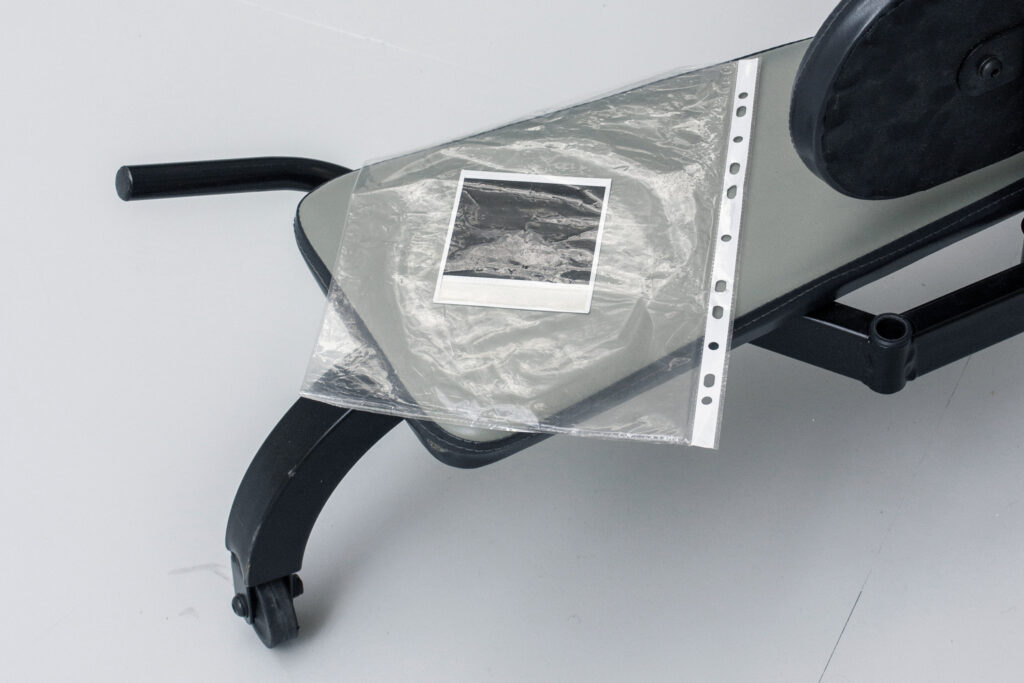
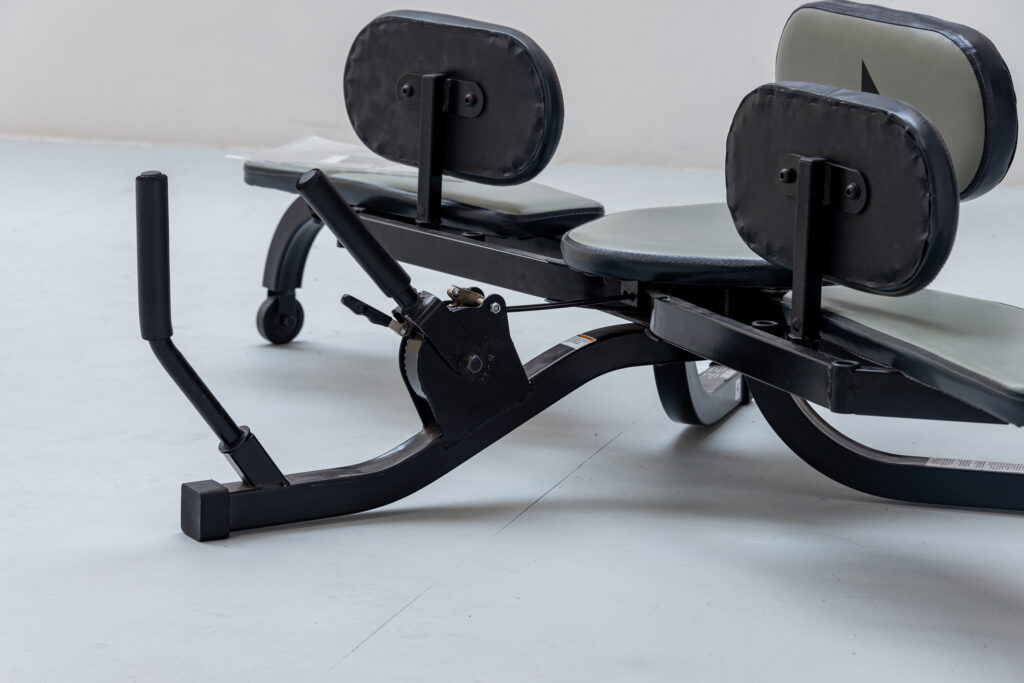
Century Versaflex; for Pantaloon is a sculptural work that brings together a vintage stretching machine and a plastic wallet containing a weathered Polaroid photograph. Intended for use by martial artists, gymnasts and dancers, the machine is designed to train the body for box splits – where the legs extend 180 degrees laterally. The photograph, usually hidden face down but exceptionally turned face up, shows an unwell newborn in a ventilator; an image of the artist captured by their father.
The machine itself is reminiscent of contemporary fitness equipment, complete with wipe- clean vinyl and functional detailing, while being sufficiently esoteric to suggest medical, therapeutic, or even sexual applications, therefore occupying the blurry space between utility and fetish. Its purpose, to push the body toward an extreme (arguably idealised) form, evokes the tension between what we aspire to become and what we are made to endure. It speaks to the contortions – literal and figurative – that shape us for better and/or worse.
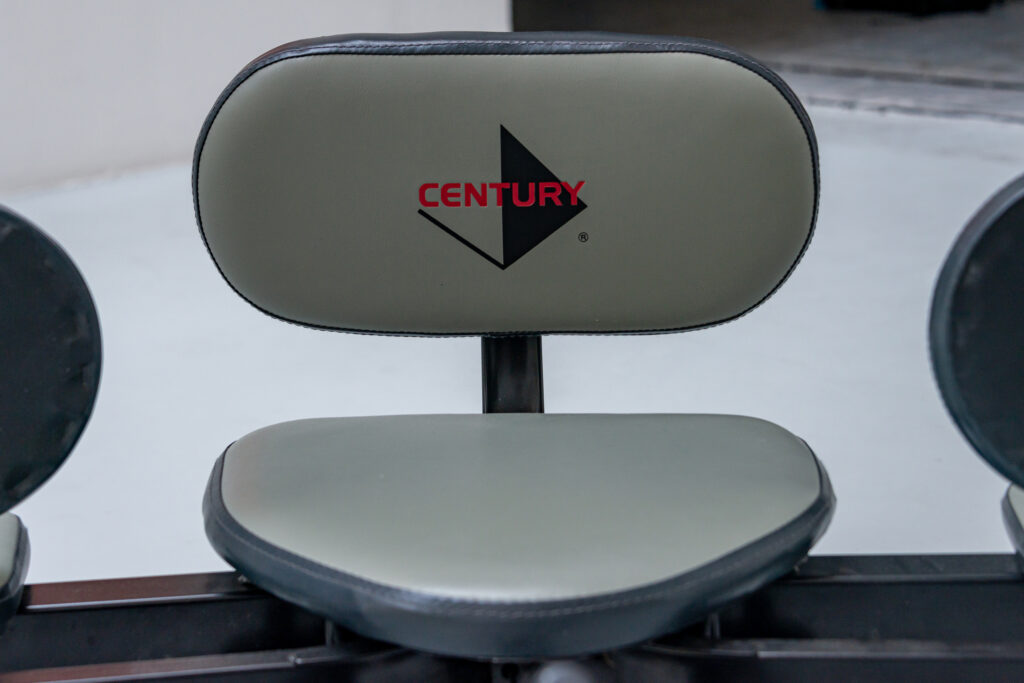
The title refers both to the brand name of the machine – part embossed on the vinyl seat amongst pyramid logo – and to Pantaloon, the stock character from Commedia dell’arte: traditionally a crooked, old man driven by vanity and greed. Here, Pantaloon becomes a conceptual scaffold, allowing the work to touch on aging, time, and dis/ability, while hacking the personal and cultural scripts we inherit and share. The plastic wallet and Polaroid act as empty narrative triggers – fragments of an opaque story into which the viewer is subtly enlisted. Crucially, the work functions as a prop, staged, waiting to be activated by an absent body; yours, mine, Pantaloons.