
Moving Discourse in conversation with the performance collective Heavyware
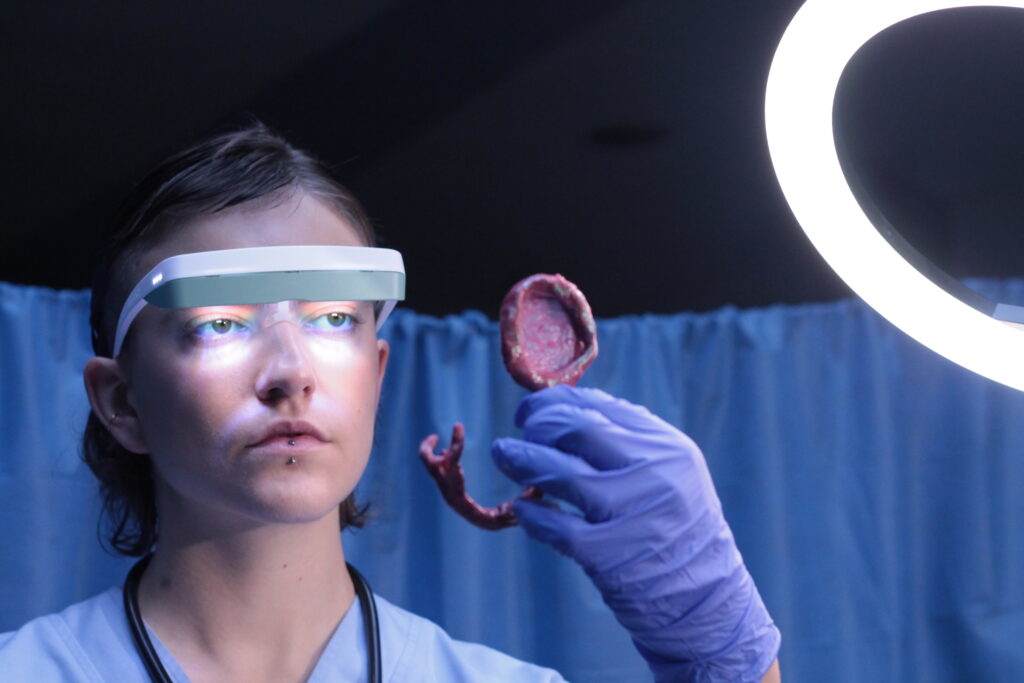
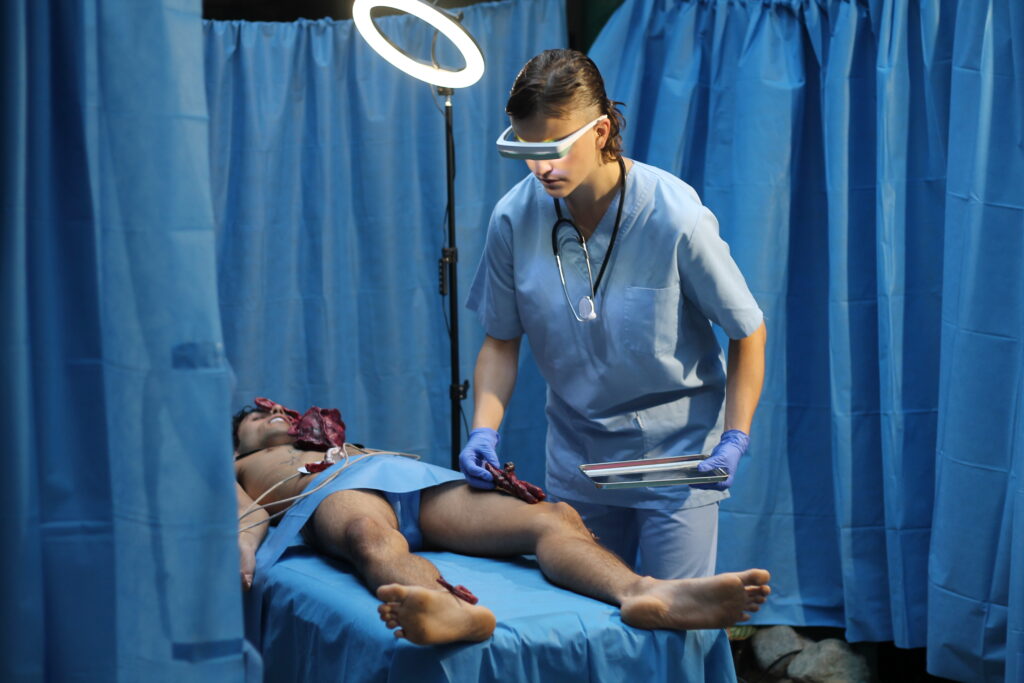
In their newest work Macroplastic, the performance collective Heavyware [Alexandra Bierlaire & Gian Sanghera-Warren] takes the spectator on a fictitious journey through Gian’s body. Set in a laboratory 200 years in the future, Alex investigates whether Gian’s organs — already infiltrated by microplastics — have transformed into cold, shiny polymers. With Moving Discourse, they explore the relationship between art and science, as well as new ways of understanding creativity and creation in the context of biotechnology. Together, we speculate about a shift in how we imagine the body and ask: can we imagine with the body? How can we harness imaginative power as a technology of resistance — resisting the current political climate, where truth appears to take only a singular form? Moving Discourse argues that reshaping, moulding, stretching this form becomes the political duty of our time.
Interview by: Imke Felicitas Gerhardt
Imke: Your project is called Macroplastic. Maybe we can start with the name? At first, I thought it was a play on words: macroplastic instead of microplastic, which I connected to the omnipresence of microplastics, resurfacing on a macro level. Then I wondered if it might be a shift in perspective: through the ultrasound you, Alex, are using to examine Gian’s body, the microplastic is magnified — visually transformed into macroplastic. Or perhaps it’s a reference to the ancient microcosm/macrocosm analogy: the belief in a structural similarity between the human being (microcosm) and the cosmos (macrocosm). Is Gian’s body — infiltrated by microplastics — an analogy to the spread of microplastics on the macro level?
Gian: It is, in a way, all of the above. I think it connects to how we are using plastic not only as a physical material, but also to explore plasticity. Plasticity as an analogy for a way of being, working, and moving. It is this idea that we are invaded on a smaller level — that we are synthesising with this material. But perhaps this idea can also be extended to the way we situate ourselves in the world. Maybe less in a cosmic sense, and more in terms of how we place ourselves within society — and how we might understand society itself as something plastic.
Alex: Yes, so we started from this trend that Gian showed me — this anxiety on TikTok about microplastics. Gian knows more about it and can maybe speak later about how the algorithm works. What’s so fascinating is that once you are absorbed into this algorithm, what you’re exposed to becomes your whole reality. We were discussing that, but also the fact that microplastics have already been found in the blood, the brain, and so on. So perhaps the anxiety that microplastics are taking over your body isn’t actually that far-fetched. Just look at the oceans — they’re full of microplastics. There’s a clear need to take action. And we were discussing, what is the middle ground between being fully absorbed by that …
Gian: Eco conspiracy versus being completely oblivious.
Alex: Yes. This middle ground is still something to be defined. That’s what we are discussing — but at the same time, we also want to explore and push toward the extreme. To question the extreme. I think this is why we chose the title.
Gian: And it’s great to work as a collective on this topic, because we can benefit from having two very different fields of interest that we bring together in this project. Much of my work performatively investigates digital trends. I was really drawn to the aesthetics of these TikTok videos — like men explaining how we should use wooden spikes instead of toothbrushes, and all the absurdity of that. My work is rooted in an anthropological interest, I suppose. Alex, on the other hand, has a deep fascination with the body — an anatomical and medical interest in how the body works. Macroplastic grows out of these digital trends, but is at the same time a very material and embodied exploration of the body and bodily consciousness. Perhaps this is our middle ground.
Imke: Yes, this trend on TikTok is fascinating because it really shapes our perception of reality. You get trapped in an echo chamber, and those videos and images become the only reality you are exposed to. It creates a paradoxical simultaneity: on the one hand, being stuck in this catastrophising, anxiety-inducing algorithm that calls for urgent action against climate catastrophe; and on the other hand, being paralysed by the addictive nature of the feed itself — scrolling inactively for hours.
Anyway, I’d like to pick up on the word plasticity that you mentioned earlier. Perhaps this is the right moment to speak about the etymology of the word plastic. Of Greek origin, it means something malleable — something that can take on any shape or form. The word performance derives from per-formare, which means to fulfil a form, to bring something into shape. Performance generates forms, and plastic can take on any form. Was this shared characteristic the reason why you — as transdisciplinary artists— chose to work performatively on plastic and plasticity?
Alex: Yes, I think at the beginning we were discussing the term plastic and plasticity, and how they can mean so many different things and be applied to so many different situations. We then began to think about them in relation to ourselves and our performance practice. Performance itself — and the way we both came to dance — is also full of plasticity. It is about trying to shape the body toward something, trying to find the right form. Plasticity can be understood as the body’s response to training: a body that develops, grows muscles, and gains strength.
Gian: Exactly — training is very much a process of moulding and casting. But plasticity is interesting for us not just in relation to the body. Part of the analogy we are developing involves a more flexible way of thinking. Plastic can be both: malleable and fixed. And when it is fixed, it can be very resistant. It has the capacity to do both harm and good. I think exploring this duality — both theoretically and bodily — is particularly compelling.
Imke: when you were speaking about plastic’s flexibility, I was thinking of fluidity. In terms of gender, we still live — or seem to be returning — to a very rigid binary system. To fit in, society demands an either/or approach: a call for unambiguity, against fluidity. Before it hardens, plastic can take on any shape. You relate this idea of plasticity to queerness — can you tell us more about that?
Gian: Yes, I think it is that. For me, queerness — especially within a creative sector — is often reduced to the identity of the maker, and that is something I struggle with. I feel that as a queer maker, your work is expected to be defined by that queerness in some way. Even when you try to resist it and do something else, you still end up responding to it. In recent years, there has even been a financial incentive to be marketed as queer, or to be seen as making queer art.
I reject that! But at the same time I can’t pretend that my work doesn’t interact with queerness, because my personhood inevitably does.
What we try to do in this work instead is to engage with queerness as an action. This is not an original idea — it comes from a long lineage of queer theory. It’s about queering rather than being labeled as queer. That means making work that, of course, can play aesthetically with queerness — which I think we do — but which is queer because of its approach to making. In the same way that queer should be used as verb, so should plastic. Plastic as a way of changing, queering, reshaping. We want to engage with queerness in a more plastic way. We know that our work is queer; we know it relates to queerness, but we try to do it in a moulded way.
Imke: I agree — the verb form is much more accurate. A noun feels somehow solidified.
Let’s stay for a second longer with the word queerness. I remember stumbling upon a sentence in your performance description where you used the word queering in the context of revealing the inside of Gian’s body. On the one hand, this made immediate sense to me: you might be referring to the discrepancy between how a body’s appearance is classified within gender categories and how that might contradict a person’s own self-perception — what they feel inside.
On the other hand — given that the performance took place in a laboratory — I was reminded of Renaissance paintings depicting early anatomy sessions. Those sessions were spectacles, where opening up the body was believed to reveal an inner truth. These paintings also mark the beginnings of modern Western science, which in turn has shaped our understanding of the binarisation of the sexes — an idea that queerness critiques.
So my questions are: why have you chosen a laboratory setting? Were you inspired by those Renaissance paintings? And finally, since modern science is deeply responsible for a fragmented understanding of the body: in your performance, you search for fragments (microplastics) using a visual device tied to modern medicine. What idea of the body do you want to communicate through this work?
Alex: Yes, for me those Renaissance paintings are extremely interesting. I find those dissections themselves fascinating — but equally, I’m struck by how opening the body was treated as something ceremonial, with all those elegantly dressed men gathered to watch. Such a big performance.
Gian: The operation theatre.
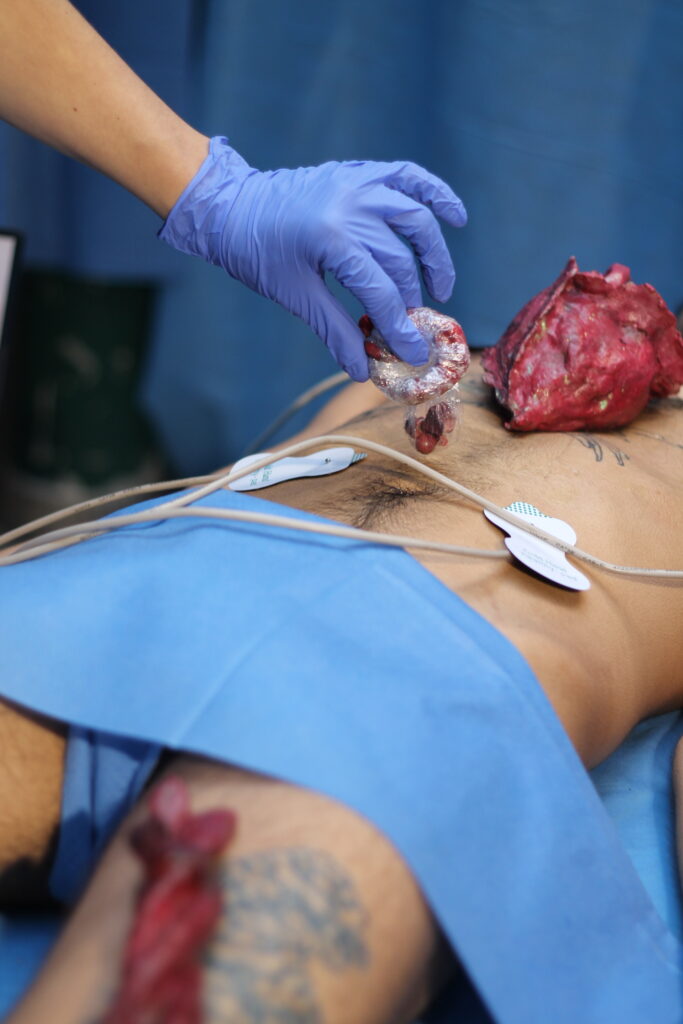
Alex: I think I approach performance as a way of dissecting the self. I have such a profound interest in the body — especially after having surgery myself. Living through that experience, witnessing how the body can be torn apart and then rebuild itself, how it can find stability again, has only deepened my fascination. What we want to portray is what we can learn from these different scales. When you see how your skin can be opened and closed, and then become an intact barrier again — it’s astonishing. I’m not a scientist, but paying attention to these small things, like a single cell in your body, feels deeply fascinating. Witnessing how something so small can do such an enormous job.
For me, it’s about learning from both the fragility and the strength of the body at the same time. The body is vulnerable, but it is also strong and capable of constant adaptation. That duality is what we want to capture in the performance — making fiction out of it.
Gian: We portray a form of resistance. We are presenting a specimen of a body that is being invaded, yet finds ways to survive — or perhaps not survive. We are not entirely sure yet. But what is certain is that it’s about a body moving through different stages of adaptation.
Alex: Yes, we play it out to the fullest — we experiment with these small adaptations on a fictive scale.
Gian: I think working with Alex on this topic is so interesting for me because the way we view the body is so different. Alex has a very visceral approach — they work with the body as something deeply physical. Whereas in my research, the body is much more of a screen, something which other references and ways of thinking are projected onto. When you asked earlier what idea of the body we are presenting or imagining in this work — my perspective is that the body functions as an archival site, which is nothing new in itself.
But recently, I’ve been looking at algorithms and thinking about whether an algorithm is not only a tool of filtration on our devices — showing us references and things that feed our curiousity — but also whether algorithms could be adapted as a way of managing and researching through our embodied archive. In a way, I translate this technological vocabulary and software back onto the body. What excites me about Macroplastic is that it presents both of these perspectives on the body. It synthesises the technological with the biological — a posthumous approach to the body.
Imke: I have one more question about the laboratory setting. The lab is strongly associated with rationality, scientific truth, and experimentation, whereas performances are usually expected to take place in art institutions such as galleries. Art, in contrast to science, is not bound to rationality—perhaps it’s even expected to resist it. While art doesn’t need to adhere to scientific truth, we nevertheless tend to understand it as offering some kind of truth—maybe a more abstract, speculative, or even higher truth.
Both science and art—despite having historically been positioned in opposition—shape our imagination of the world. In your work, you fuse art and science not only on an aesthetic level. What potential do you see in linking fact and fantasy?
Alex: I think on a larger scale we should be having discussions with people from many different fields of expertise. Working in a multi- or transdisciplinary way is far more fruitful than staying separated. Combining different forms of knowledge and approaches is, in my view, what needs to happen. Our work is inherently multi- and transdisciplinary, and we both gain so much from this collaborative way of working.
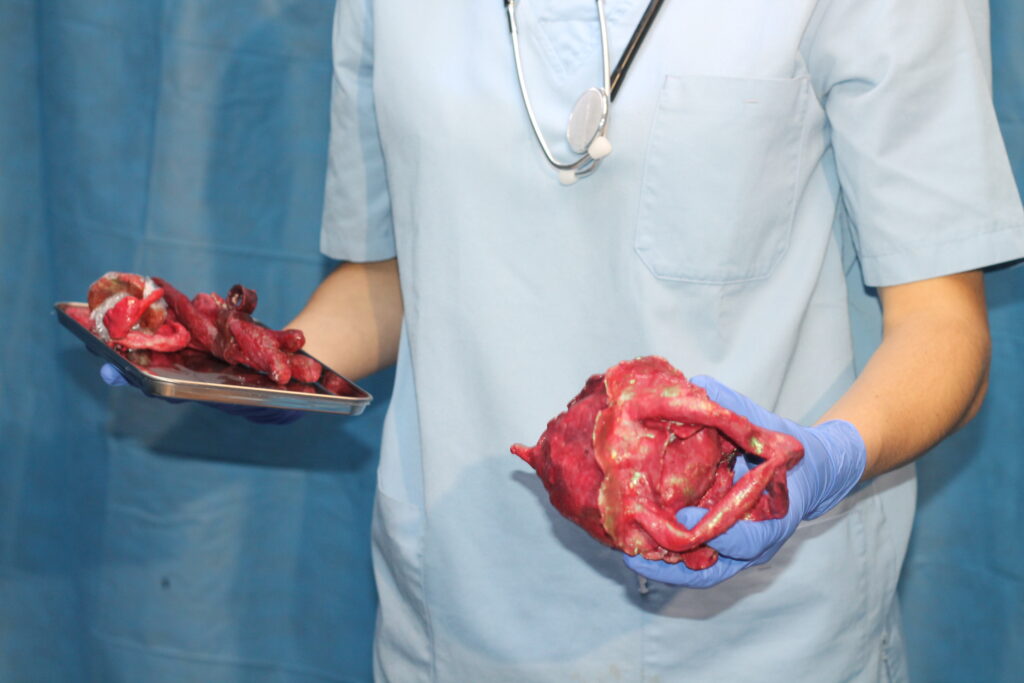
Gian: To me, this also relates to the creative process of Macroplastic. There was a lot of experimentation and working in areas where we don’t have prior knowledge. For example, we were working with 3D modeling software and animation — fields in which we have no formal training. But the question becomes: how can we use as many tools as are available to us in order to convey the knowledge and curiosity that we do have?
Alex: And again, it is also about playing with words and transposing them onto different things.
Imke: Okay, this is my last question. I want to speak about time and link that to imagination. Imagination is closely tied to the visual sense. When we imagine something, we usually envision it in the future.
Your performance is interesting, because it contains multiple temporal layers. Not only is it set in the future, but you also operate with a future perfect in regard to the sedimented particles. Those particles become visible through your use of an ultrasound, creating abstract images — a visual device that allows us to envision the future.
In that context I’m thinking about the relationship between imagination and materiality. With the ultrasound, you envision the future, yet Gian’s body is still materially present in front of us. In a performance setting, how can we create fiction with the body when it has a tangible, material presence in space? Does doing so require the use of language or visual technology to project a future image on stage?
Gian: Yes, we are basically fucking with time. We include many different temporal layers: we set the performance in the future, we work with physical material, and we engage with a body that is obviously alive and aging. So if we were to repeat this performance…
Imke: Yes, wait! There’s another layer to consider: plastic. Plastic does not age; it is not degradable. It essentially resists the inscription or imprint of time. In contrast, the body—as you were saying—ages. And the particles that sediment in the body also materialise time in their own way.
Gian: Exactly. On a practical level, we are working with a combination of live performance and performative elements. We have a video that we’ve already recorded, which we use to disguise and abstract time. It’s also about having fun with the idea of science fiction — not only in the ways we’ve discussed, but also in terms of its aesthetic. The aesthetic of science fiction is incredibly fun to play with, experimenting with different materials and scenic ideas that will hopefully create a transient and temporal space.
Alex: Yes, but we are also inspired by the past. We are playing with time and the time scales of things. It’s as if we are creating our own rules for the world we are building within the performance. It’s particularly interesting to play with plastic — something that has aged longer than the body, or let’s say, operates on a different time scale than the body it inhabits.
Gian: Yes, and I’m also thinking of it as a vision of the future that exaggerates the present. It is linked to this moment in time, but it also raises questions about nostalgia. I feel that the meaning of time today is completely different than it was ten years ago. The circularity of time—especially in the trend-based work I’m interested in—is so different now. Everything is exaggerated. We can only speculate whether what is aesthetically present now will also present then? Maybe not, but maybe is has nevertheless come back three times in the meantime. I don’t know, but I think it’s a lot of fun to play with that.