
The phenomenology of trans-masculine gender flux in performance
In a political climate that demonises and pathologises trans realities, this insightful text by performative researcher Kars Dodds is both an intimate documentation of their own being in flux and a political call to action. Responding to the persistent absence of trans-led inquiry within academic discourse, Dodds’ embodied, phenomenologically centred methodology not only addresses significant epistemological gaps but, through the positioning of the Self as both subject and object of research, simultaneously enacts a political gesture of queering and destabilising the epistemic rigidity of academia itself. This writing — and Dodds’ artistic practice more broadly — is situated within the context of queer theorists such as Sara Ahmed, T.J. Bacon, and Susan Kozel, and is influenced by queer artists such as Wet Mess and Cassils. Yet, while this text engages with those queer voices, its sensitive tracing of trans-masculine corporeality allows it to become something of its own.
Author’s note: This piece was completed in September 2024 and addresses the social climate facing the trans community up until that point in time. With the current risk of segregation as a measure to remove trans people from public life, the gender flux I describe has become an even greater risk in the past year. The core of my work lies in a yearning for freedom of expression for all. None of us are free until all of us are free. Free Palestine. Free Sudan. Free Congo.
This piece is a protest of trans visibility by documenting and discussing my experience of ‘having tits’ as a trans-masculine person. This text is built on the research for my work Trans-masc Tits: WHY NOT CHOP THEM OFF which confronts readers, viewers, and myself with the aggressive realities of gender dysphoria, specifically chest dysphoria as experienced by individuals assigned female at birth (AFAB), while also allowing for ambiguity and the irreverent pleasure of being trans. The phrase WHY NOT CHOP THEM OFF originates from my practice, the ambiguity and potential for misinterpretation of which are deliberately employed as a provocation. Being trans is not a pathology, and there are many pleasures to this semi-dissociated relationship I have with my tits. The joy of being this way is that there is no given way to be. There is space and endless permission to fail my undefined gender joyfully. While undergoing periods of gender questioning, there is a gender ambiguity that offers an abundance of possibilities to the individual. In itself, being trans provides a natural liberation from gendered social expectations. The continual questioning and discovery have given me the most immense joy and pride in myself and being trans.
It is my hope, first, to provide an example of raw trans visibility for anyone who is questioning their gender identity and finds themselves confronted by transphobic attitudes and institutions. Secondly, I hope to provide a reference and example of in-betweenness in the transition process for artistic and academic discourses, where binary gender is dominant.
Beyond my interests, this writing — along with my ongoing performative exploration of the topic — counters current Gender Critical discourses across academia and socio-political dialogue. My motivations for this research are personal, where I firmly believe that the personal is political. I attest to the challenges my identity, body, needs, desires, and those of those within my community face.
Positioning the Self: On Motivation and Method
On a broader scale, transgender visibility is increasingly essential as anti-trans legislation, institutional transphobia, and Right-Wing ideologies continue to chase us with metaphorical torches and pitchforks. Trans people, and our allies, are tasked with amplifying our voices for our right to healthcare, safety, recognition and unadulterated, messy, loud, colourful, authentic queer joy — none of which we take for granted. Historically, queer resilience, protest, and community have been our primary tools for survival towards the visibility we have today. Current matters show that while we are more visible than ever, we still bear the weight of excessive discrimination. The United Kingdom has witnessed rampant and unfiltered transphobia across the lead-up and aftermath of the 2024 General Election. Trans kids, young people, and adults have been mocked and used as political pawns, for example, in the public and political coverage of the transphobic murder of teenager Briana Ghey. Rishi Sunak openly mocked trans-womanhood while the teenager’s bereaved mother sat in chambers. Keir Starmer, in retort, publicly shamed the then Prime Minister (Courea, 2024), an act of allyship he is yet to remain firm on post-election.
The vicious acts of transphobia, gender critical discourse, and conservative politics that mock and dehumanise trans people make being transgender in this environment a deeply challenging experience.
In a societally hostile environment, where possibilities for identification are limited or absent, queer people are compelled to cultivate resilience and the strength to orient and locate themselves within an unwelcoming society.
This often exhausting process of seeking orientation is examined by queer theorist Sara Ahmed, who, in Queer Phenomenology, introduces the concepts of orientation and disorientation. By doing so, she demonstrates that queer people are tasked with finding themselves constantly without the privilege of seeing themselves within the world (2006, p. 12). It goes without saying that in many communities and for many people, this results in denial and shame of the authentic experiences of the Self, or rather Self/s which I later explain. This highlights a social determinist frame through which queer visibility and resilience are limited, varying from individual to individual.
I encountered significant challenges navigating a binary-conceptualised world throughout my career as a professional dancer, especially within the rigidly gendered structures of the ballet world. While training and performing in ballet and contemporary dance styles at a professional level, I experienced more than ten years of gender questioning.
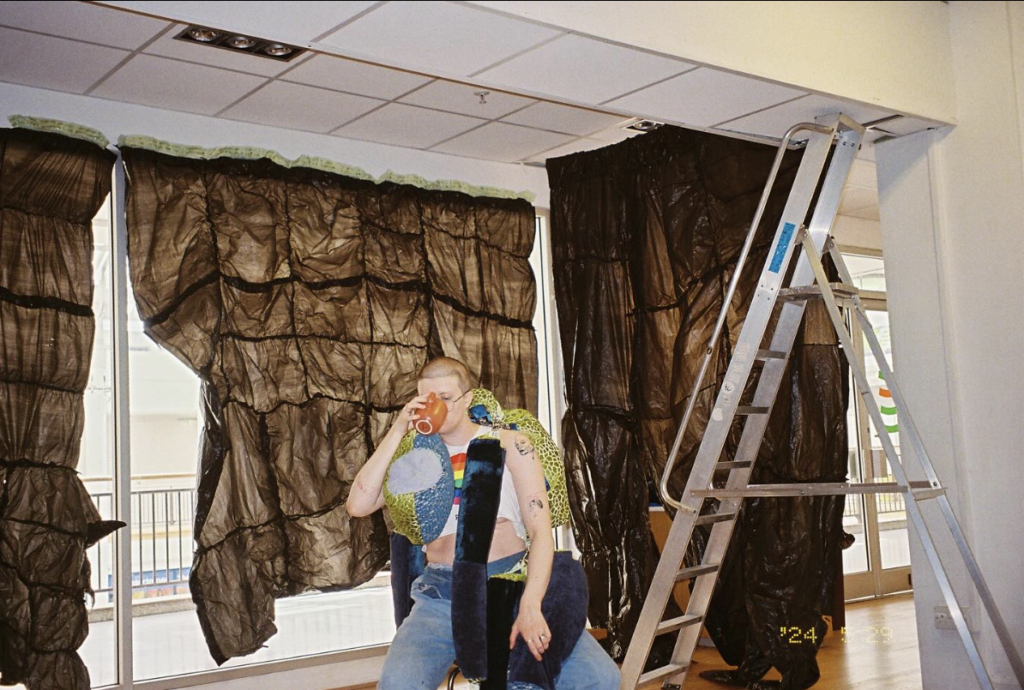
My first notable experience of gender dysphoria took place while preparing for a run of The Nutcracker (an annual ballet tradition). I could not recognise myself in the mirror as I painted my face and strapped myself into a tutu in the dressing room. This incongruence continued to fluctuate and peak over the next 3 years. I then came out as non-binary and started to decrease my commitment to technical dance training. I lived proudly under these terms until moments of masculine certainty became recurrent in 2021. These experiences and an ongoing incongruence with my trained artistic medium led me here, where the overlapping incongruence between my gender identity, embodied experience, and trained performance practice requires my attention towards reclamation.
Inspiration for reclaiming my artistic practice came from queer artists whose work exists beyond traditional canonical frameworks in dance, sculpture and performance art. One of those artists is Katy Pyle, who is the founder and director of Ballez, a queer New York City-based ballet company. With their company of queer and trans dancers Pyle has created a place for queer stories and bodies within the canon of story ballets and the ballet class framework. In their forward to (Re:)Claiming Ballet (2021) Pyle discusses the importance of reclamation from the traditions of ballet that made them betray themselves. They write “This applies to technical standards as much as dress code and classroom decorum. And we carry this lineage in our bodies right alongside our technique. These deeply internalised value systems do not just damage us, they also isolate and fractionalise us away from one another” (2021, Pyle). Similarly to Pyle, I easily lost my authentic sense of Self in the traditions and normative patterns that ballet drilled into my body. The eroded Self that remains, I perceive as being in a transitory place that fluctuates from affirmation, and dysphoria, and results in a messy, complex gender experience. In my current separation from ballet and dance performance, I am reclaiming both my Self and my artistry. Pyle has found a reclamation in redefining the norms of ballet, while I seek reclamation by expanding the mediums through which I create to make sense of my gender identity through bodily and material explorations. This expansion is like stretching the concept of the self, allowing fluidity and plurality to emerge.
The fluidity of Self/s that inhabits the gender-diverse individual throughout their lifecycle and the orientations they navigate socially and somatically, generates a multiplicity of opportunities for orientation. Normative notions of the biological body, gender, identity, and sense of Self are all opportunities for orientation or disorientation in contextualising ourselves and our experiences. Orientation towards the body as a place for making sense of things, for me, is occasionally disorienting due to the unpredictability of my gender dysphoria. The centrality of my tits within my dysphoric experience ironically informs my identity as a way of orienting me socially and internally as a trans-masculine person.
On tits.
In the title of this work, I intend for ‘tits’ and ‘chop’ to stand out as colloquial expressions to disrupt formal academic linguistics and in an effort to reclaim them against my chest dysphoria. While each reader will hold different associations and reactions to the word ‘tits’, I chose to use it in protest and for the reclamation of my own body. ‘Tits’ holds a negative, patriarchal connotation that sexualises and objectify cis-women, trans-feminine people, and trans-masculine people with tits. As part of my research I explore the historical etymologies of the Oxford Dictionary and my trans-ed relationship to ‘tits’ and ‘chop’ to define my use, and relationship to the words themselves.
‘Tit/tits’ are now most typically used as slang to indicate a person’s breasts (Oxford English Dictionary, 2024). As an object, ‘tits’ then become a source of sexual desire and degradation. The original use of ‘tits’comes from Old English (5th century to 1066) to refer to the teat or nipple (Oxford English Dictionary, 2024). This first use of tit/tits references both human and animal bodies, suggesting a dehumanisation that likens women’s bodies to milk production in livestock, assigning a capitalistic market value in alignment with the body part. In later uses, ‘tits’turn almost exclusively to the bodies of women/AFAB individuals when implying sexualisation or sexual attraction. Since 1881, ‘tit’ has been used as an insult, meaning ‘idiot or fool’ (Oxford English Dictionary, 2024). This meaning degrades the individual to establish a hierarchy of worth and power between the insulter and the insulted by othering the insulted. By choosing to use this word of dense weight and history, I feel I am able to reclaim the sexuality, gender, and objectivity of my body. Descriptively chop is satisfyingly aggressive and definitive. To chop is defined as “transitive; to cut with a quick and heavy blow; now always with a hewing, hacking instrument, as an axe or cleaver; formerly also with a sword” (Oxford English Dictionary, 2024). The use of the word is productively destructive, in the same way that top surgery is to someone with chest dysphoria. Simple, only one sharp movement and done. As a noun, ‘chop’ refers to a type of meat, generally a rib (Oxford English Dictionary, 2024). Meat comes from an animal that is, or once was, alive. The act of chopping separates the object of material value from its aliveness to serve another purpose. In this sense, I could consider my tits already chopped. They may be mine in their attachment to my body. Yet I frequently experience them as disjointed, separate from myself. As a trigger to my dysphoria, they are perceptively other, in a denial of somatic attention. I bind them with tape or cover them with layers of clothing. And I pull, poke, and prod at them. In this, there is an in-betweenness of dysphoria and euphoria, and ownership and dis-ownership – where I can happily act on them as an object. Undoubtedly, I want to chop them off, to disown them and find myself imagining my body, myself, and a life without them. Me and my tits, somehow connected in flesh but disconnected in Self. I discover safety in self-objectifying my tits, as it affirms them as an object. It is as if I can reclaim my ownership of my body and identity, and of my tits, by rationalising them as an external object.
Fuck the ‘stages of transition’
The trans-masculine frames my inquiry into the lived experience of ‘having tits’ to infer that, as a trans-masculine person, my tits are a significant trigger to my gender dysphoria, causing me to experience chest dysphoria. Gender dysphoria is defined as “when a person experiences discomfort or distress because there is a mismatch between their sex assigned at birth and their gender identity” (“Glossary – TransActual”, 2024). Additionally, gender dysphoria is a clinical diagnosis that is compulsory for gender-affirming surgery referral in the UK. For trans-masc people, this commonly includes a subcutaneous mastectomy, or colloquially ‘top surgery’. A common experience when coming out is that the surgical status of the individual’s anatomy becomes the first object of interest to the other party. Shon Faye and Travis Alabanza cite this experience in their respective works, The Transgender Issue (2022, p. 64) and None of the Above (2023, p. 41). In the UK, the National Health Service (NHS) allows self and GP referral to Gender Identity Clinics (GIC), where waiting lists are notoriously long. This creates a significant barrier for trans people, as there is an elusive and undefined waiting period (Zaccaro & Fagg, 2024). In protest, a group of trans youth from the UK-wide action network Trans Kids Deserve Better scaled to the ledge of the NHS offices in London Waterloo to protest the NHS-commission Cass Report that led to the nationwide defunding of puberty blocker for trans people under 18 (Stonewall, 2024). They camped out there for 4 days. One activist, Deb (17), mentioned their mantra while camped out on the ledge, “it’s safer up here than on the NHS waiting list” (Baker, 2024). Deb’s words are visceral and capture the mental state of trans people across the UK, myself included.
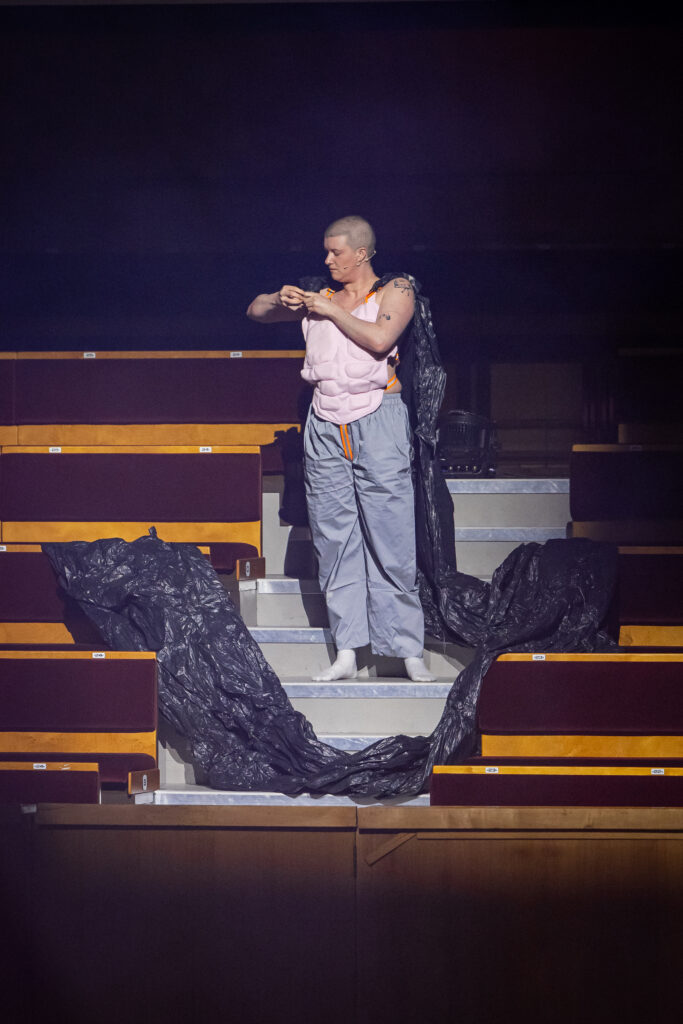
The stages of gender transition, as they are understood and most commonly communicated, are incomprehensive and oversimplified categories that suggest an unrealistic linearity. The stages include self-discovery, social transition, and medical transition. This provides a linear timeline for gender discovery that is unattainable, if not impossible, for non-binary-leaning trans people. In 2023, an Interpretative Phenomenological Analysis (IPA) study on the trans-masculine experience of care in GICs showed that the medically accepted ‘stages of transition’ were commonly rejected by participants as a way of gatekeeping affirming medical intervention. Instead, participants were tasked with fitting their experiences into these stages to make them ‘convincing’ enough to receive medical attention (Mills et al., 2023, p.21). Fluidity, non-linearity, and flexibility within the gender binary and approach to transition were outside of the medical understanding of transness as a pathology. Mills et al. show that this rigid approach to transition was not recognised by anyone within their pool of participants (between the ages of 23-44) as they discussed coming out and discovery as a ‘life-long’ process, not a mere ‘first stage’.
In my work, I am curious to investigate the decision-making process and waiting period between social and medical transitions. ‘Social transition’ defines the period in which an individual makes social changes to align their social experience to their gender identity, e.g. using a new set of pronouns, a new name, or changing their appearance (TransActual, 2024). Frequently, in the common binary understanding of transness, this occurs before any medical intervention as a way of ‘trying on’ and ‘trying out’ new forms of gender expression. Though there has been a significant shift towards self-referral in gender-affirming care, you are required to have lived socially as your preferred gender for at least 2 years to get a gender dysphoria diagnosis and gender recognition certificate (GRC). The diagnosis is no longer required under the Equality Act 2010, which protects UK citizens from discrimination across all aspects of life. Still, a GRC makes the process of accessing referral to gender-affirming surgery smoother. The Labour Party has promised to review and make the process simpler. However, this announcement preceded Prime Minister Keir Starmer’s public agreement with J.K. Rowling, in an interview with The Times, said that trans women should not be allowed in ‘biological women’s spaces,’ referencing the ongoing transphobic argument that trans women are merely predatory men seeking access to women’s spaces (Swinford, 2024). The requirement for a diagnosis and GRC act as a way of gatekeeping gender-affirming care from trans people (Ashley, 2019, p. 480). As a prerequisite to affirmative care, it functionally prolongs consistent experiences of gender euphoria and delegitimises the person-first trans experience. It also means the individual must tackle the dangers of ‘not passing’ or being perceived as trans during this period. In 2020, an IPA research study examining gender dysphoria found that alongside experiencing dysphoria, research participants experienced both negative social consequences due to their gender identity and internal processing of rejection and transphobia (Cooper et al., 2020, p. 7). Thereby informing the complexity of the gender dysphoric and trans experience through internal and external perception(s).
On a cultural level and among general populations, transness is oversimplified, making it easier for us to be othered and demonised.
I did not identify as trans-masculine when I began this research project. I identified as non-binary, used ‘they/them/theirs’ pronouns, and therefore initially framed this research as a look into the assigned female at birth (AFAB), non-binary/gender non-conforming relationship to having tits. Engaging in this project took me from a place where I was most comfortable using ungendered language to describe myself and my body and where I was ambivalent in my transness. This is not to say there is a linear pathway, nor that my gender journey has been linear, but that engaging in research surrounding myself and transness was essential to get here. This switch in language demonstrates the emergence and acceptance that occurred throughout artistic practice, where I confronted my body and gender dysphoria on a ritualised basis.
Existing in this in-between, flux state of gender is both an internal and external experience of genderfuck. The term ‘genderfuck’ traces back to Christopher Lonc’s article Genderfuck and its delights in 1974, where Lonc used the term to describe the pleasure and self-satisfaction he gets from dressing in drag and the importance of this satisfaction beyond any need to “dress for others” (Lonc, 1974, p.4). The term has since been used to describe the complicating and destabilising visual expressions of gender against cis-gendered and heteronormative roles (Reich, 1992, p. 113). While not exclusive to the trans experience, within the context of 2024, genderfuck could be used to contextualise as an approach to social transition in the face of gender dysphoria.
An inspirational performer who materialises genderfuck in their artistic practice is Wet Mess.
Wet Mess is a movement artist and drag performer whose recent solo production Testo aims to “messify transitions, testosterone, and the edges of drag” (Mess, 2025). The show presents the attainability of the transmasculine dream through desire and expressive exploration. While moving through their dreamlike world, the words “This is not a dream” appear on a screen (Kirkpatrick, 2025). This use of words to frame impressions of viewers brings the reality of living in a transmasculine, queer body, where your material reality has an untapped potential that while attainable may not be accessible. The tangle of this reality, as presented by Wet Mess, creates new possibilities for masculinity and transmasculinity alike, thereby removing binary gender expectations by sheer lack of resources. This work, and the existence of Wet Mess within the London drag and movement community, points directly to the irreverent pleasures of transness that are the heart of my artistic works.
Wet Mess makes their non-binary, trans body (with tits) visible during the work, which strips back the masculine edge of their usual latex chest plate. This work exists closely to the world of drag cabaret, which I explore in the first performance piece as part of this research, my TRASH GENDER solo (March 2024). Though Wet Mess investigates testosterone in transmasculine gender transition, their ‘messification’ of transmasculine gender transition demonstrates a similar in-betweenness and flux which I am exploring through the exploration of top surgery.
Performance Phenomenologies
In this writing and in my practice as research (PaR) in general, I engage phenomenology across artistic mediums to explore the subject/object split between my identity and body in states of gender dysphoria, euphoria, and what lies in between. Using Interpretative Phenomenological Analysis (IPA), I analyse my embodied accounts of performance encounters to discover thematic commonalities across the chronology of my research. I aim to disrupt familiar narratives of transness specific to trans-masculinity to demonstrate the authentic fluidity and in-betweenness that is systematically overlooked by prejudice and medicalisation through the common oversimplification of the gender binary (Mills et al., 2023, p. 16).
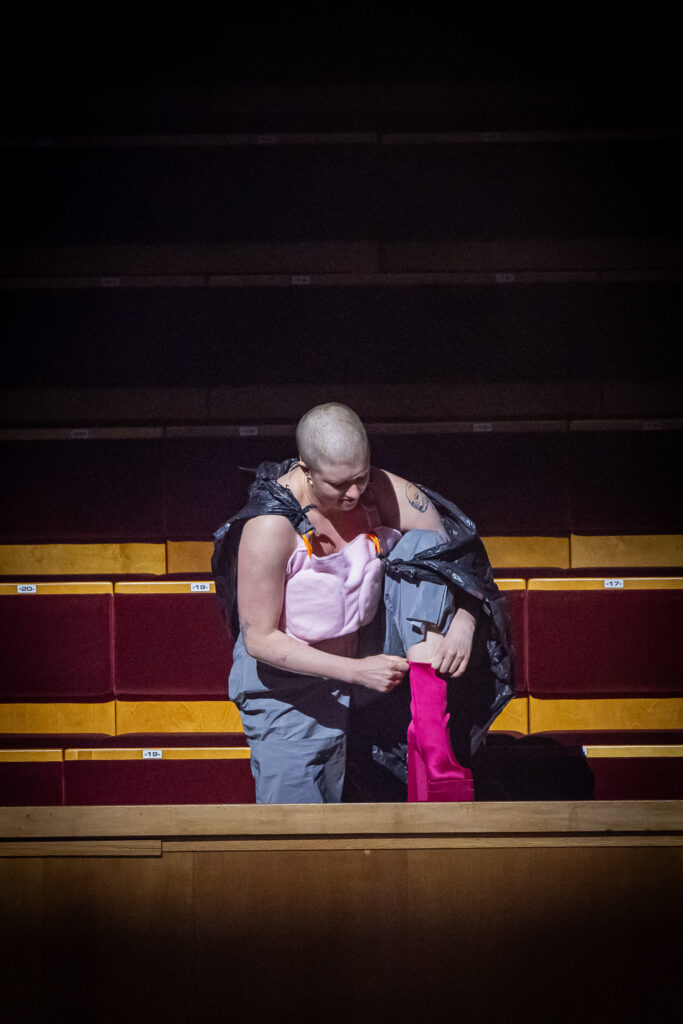
In regard to my phenomenological approach I particularly apply and explore the phenomenological concepts of T.J. Bacon, Susan Kozel, Amelia Jones and Sarah Ahmed. I draw on Bacon’s concept of multiplicity of Self/s to understand and make sense of a fluid approach to gender transition, hoping to demonstrate the freeing nature of non-binary and non-conforming approaches to being trans-masc (2016). Additionally, Ahmed’s Queer Phenomenology offers an understanding of orientation that highlights the importance of trans visibility (2006). Kozel, Jones, and Bacon engage in a transdisciplinary application of phenomenology across performance practice and art-making that aligns with the theories and methodologies.
T.J. Bacon’s term ‘Self/s’ describes the multiplicities experienced by the performance artists as they engage in a performance encounter. The capitalised ‘Self’ is a construct between body and mind that together acknowledge “an [empirical] embodiment and a simultaneously separate [intellectual] disembodied side” (2023, p. 10). Linguistically, Bacon implies that the presence of the Self is not singular within the moment of performance or ever. In and after a performance encounter, both the performer and the viewer(s) have time to make sense of the ways in which they exist in our relationship with each other and themselves. It is impossible to ignore the unique sensory experiences of our physical bodies and the external conditions of the environment and society surrounding them. An individual who identifies as gender diverse, trans, or non-binary, such as myself, exhibits a disillusionment with the societal norms that are culturally intended to inform them, their Self/s, and their embodiment.
Bacon describes their use of the term ‘Self/s’:
This ‘/’ does not indicate the word, ‘or’, but instead acts to account for how something may be phenomenologically experienced as in a state of flux. For example, the shifting perception of a Being between points of manifestation and perception may be read as de/re/constructed, not in the Derridean (2009) sense of deconstruction, but rather in the poetic-logic of the poiesis previously mentioned and to be established further through this book. The artist-philosophical expression of ‘Self/s’ indicates the potential to understand Self as a multiplicity of binaries in harmonious reciprocity, conflicting flux or oscillating evolution. (Bacon, 2023, p.7)
Bacon’s ‘Self/s’ aims to capture the ‘state of flux’, or transitory, experienced in moments of identification, emergence, and re-birth. In my methodology I draw on Bacon’s use of the capitalised “Self/s” to signify the dynamic aliveness of the Self/s as theoretically separate from the human body. For my purposes, the body serves as a vehicle for feeling, experience, and exploration to align it to the Self, the multiplicitous subject. Such moments are ever present in Self-exploration, for gender discovery and artistic development.
Bacon uses an eidetic reduction, a process to describe the essential nature of something, to clarify and communicate the nature of perception within the performance encounter as a catalyst of risk, applicable to both the performer and the viewer (2023, p. 12). Emerging from the performance encounter, the viewer and performer experience a multiplicity of Self/s. Bacon’s earlier work affirms the fluidity and abundance that has been all consuming throughout training and career in performance, as well as my gendered mind/body relationship and internal dialogue. This dialogue has evolved throughout my gender transition at seemingly chronicled events, presenting a narrative that can only be understood in reflection. Further, Bacon argues that performance encounters are not immediate or fleeting, countering Peggy Phelan’s notion that performance only lives in the moment (1993, p. 146).
As a lifelong performer, Bacon’s theory of Self/s affirms and describes both my experiences of performing my living gender and how these experiences are understood in dialogue. My mind-body is the medium for my gender and performance practice. Therefore, neither can exist independently of the other. Bacon’s application of their theory demonstrates the aliveness of a performance encounter “from anticipation through journey to pre and post encounter and the shifting memories or conversations after the event” (2016, cited in 2023, p.17). Throughout the shifts of perception surrounding a performance encounter, there are interactions between one’s own experience of Self/s, other individuals, identity, and politics. The grasp through which we encounter politics in life is multiplicitous. We encounter media, news, and interpersonal body politics. All of these boil down to a performance of power, essentially (and most crucially for this research) material power.
In-between body and mind — In-between the other and me
The performative researcher Susan Kozel uses the work of Maurice Merleau-Ponty and Edmund Husserl to inform her interdisciplinary approach to phenomenology, which she approaches as a performer and digital artist. She describes the temporal-spatial relationship of the Self as a context that informs the lived experiences. She writes, “Phenomenology invites a duet between the reflective and pre-reflective” (Kozel, 2007, p. 16). Kozel’s discussion of the context that precedes reflection points towards the impact of the individual’s personal histories, memories, and mis-rememberings on the subject. While this is not strictly Kozel’s argument, it is through these relationships that individuals define their trajectories. The influence of social norms orients the body and Self/s of the individual within narrow constraints, impacting both their orientation and self-understanding.
Both Kozel and Bacon take an interdisciplinary approach to phenomenology by integrating discussions of art practice, performance, and viewing.
By utilising the work of both theorists, I aim to speak to the embodied split from Self as experienced in gender dysphoria and gender euphoria. I do so using my artistic practices as a vehicle to examine my multiplicitous history of embodiment and the in-betweenness that inhabits the relationality between me, my tits, and the subject-object split between the Self/s and the body. The body of the transgender subject challenges conventional notions of female/feminine and male/masculine subjects by displaying an outright social incongruence, or in-betweenness, of gender.
Another thinker who has examined the integral role of the body in the context of art and who has inspired my work is Amalia Jones. In Body Art: Performing the Subject, Jones argues that body art enacts a confrontation in subjects that “exacerbate, perform, and/or negotiate the dislocating effects of social and private experience in the late capitalist, postcolonial Western world” (1998, p.1). The internal and external worlds are assumed to be aligned. However, body art reveals the dislocation through protest by including the lived body as an artistic medium. A similar, non-intentional dislocation occurs in the gender dysphoric experience. In theory and practice, this work focuses on dislocating, chopping, refiguring and re-identifying the experience of trans-gendering the Self using the body as a medium for affirmation.
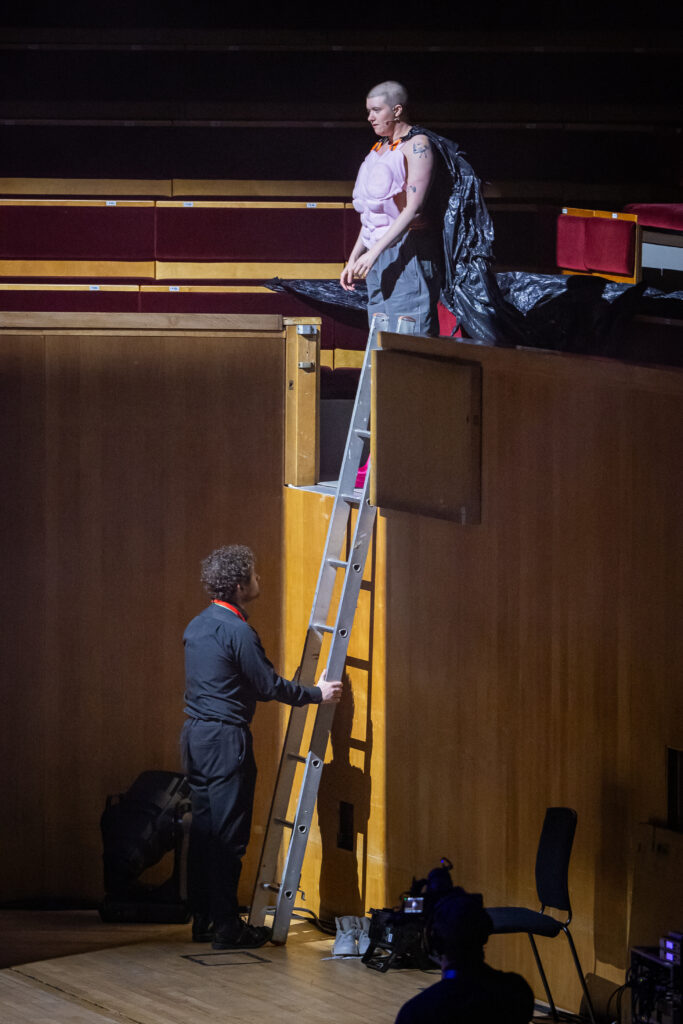
As for Bacon and Kozel, so too for Jones: practice and theory are intertwined and used to reveal experience and subjectivity. Subjectivity comes into play in body art and its political notions in the performance encounter, as the inner life of the artist interacts with their subjectivity and intersubjectively of viewer(s) inner lives (Bacon, 2023, p. 38)
Jones quotes Schneeman’s reflection on the visual sensation and information provided by the eye to the performer in understanding what she calls the “visual kinaesthetic dimensionality”, which she describes as “a visceral necessity drawn by the senses to the fingers of the eye… a mobile, tactile event into which the eye leads the body” (Schneeman, cited in Jones, 1998, p. 2). Jones contextualises this ‘event’ as a dislocation between the private and social perceiving subject. Schneeman’s description of the eye as a tactile sensory organ points towards a somatic, felt knowledge within the body. I understand this as a psychological projection of Self in the visual field. This describes a somatic experience of Self/s, which Jones would likely describe as occurring between the body and the Self. Jones uses “body/self” to acknowledge that in body art, or live art, both the body and the person/Selfhood of the artist are engaged and cannot be separated.
A queer performance artist whose work investigates the intricate relationships between social and private experience, the possible misalignment of external and internal worlds, and the dual function of the image — as both an imprint of reality and a projection that participates in constructing it, is Cassils.
Cassils’ Becoming an Image is canonical to trans studies and performance art. In this performance piece, Cassil attacks a 1500-pound block of clay in the dark, while a flashing camera captures small moments of effort for documentation (2011a). Live audience members then are only able to see the performer at the same time the image is taken, by the light of the camera flash. The audience hears the effort and attack of the performer throughout. The effortful endurance and impact are visible within the dents made to the block of clay. Cassils describes the resulting sculpture as a “faithful index of every elbow, knee, and fist that I throw; and although it is made by my body, it is a formal representation of violence” (Cassils, 2019, p. 119). The clay mirrors the impact of the violence on the performer’s body and acts as an archive of the attack. […]. Another work of Cassils is a 2-channel scale projection called Fast Twitch/Slow Twitch (2011b). On the left is a 23 weekly time-lapse of the artist’s body-building progress which shows their frame becoming more muscular and masculine in appearance. To the right videos show the artist’s body flexing their muscles, and making strenuous facial expressions while lifting weights, and eating raw meat, eggs, and supplements. Side by side, we see the effort in slow motion alongside the results speed up.
The captures attempt to blur the line between the performative of masculine fitness and its relatively mundane effects on the frame of the body. For this work, Cassils demonstrates the clear change in their bodily composition.
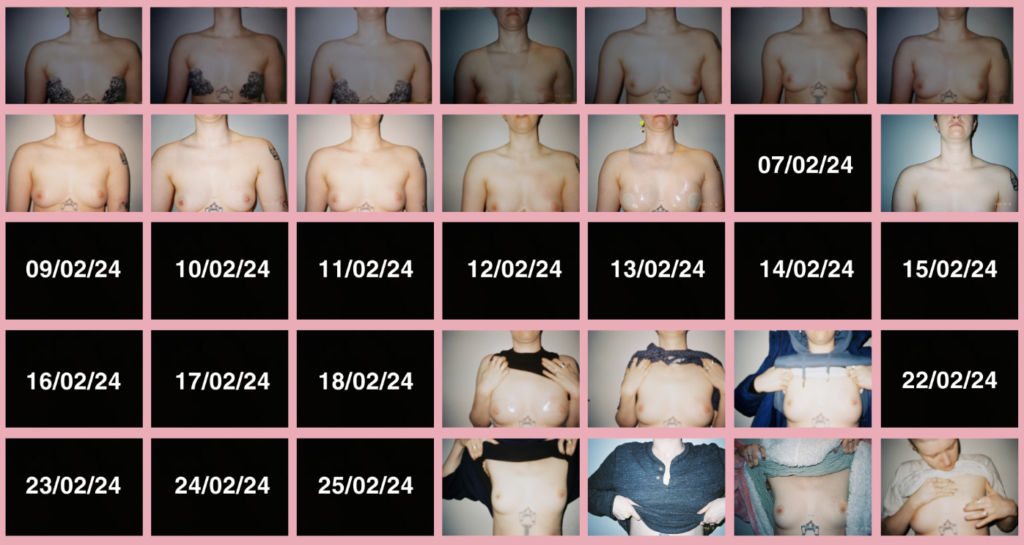
In my own practice-as-research I used a similar method to capture change — or the absence of change over time. In daily tit, a score in which I document my chest every day, I use the camera to confront my ongoing chest dysphoria. My use of the camera has the potential to show change, but instead demonstrates time spent with my unchanged appearance and chest dysphoria. The score enforces regular moments of confrontation within my body and Self to make peace with my bodily reality and related dysphoria, while also offering a timeline of trans resilience and wilful patience.
Closing _
Gaps
Throughout my review of relevant academic literature, social context, and artworks, I have noticed several notable gaps this research has begun to fill. First, there is a lack of trans-led research on the lived experience of being transgender. As a marginalised group, trans voices are othered and undervalued, particularly when it comes to our uses of social services for gender affirmation. Effectively, decisions and research about us are made without us. This furthers the pathologisation of transness that alienates us from feeling like ourselves. Secondly, among IPA studies on trans experiences, there is a significant disparity in the trans-masculine, assigned female at birth (AFAB) representation in research subjects and participant pools. While I am not engaging a pool of participants, the holistic nature of being my own research subject/object is intended to queer and disrupt academic rigidity, with the potential to provide something new to ongoing work throughout transgender studies.
Throughout this research process, I began to accept myself as trans-masculine. In the beginning stages, I referred to myself and this project using the terms ‘non-binary’ and ‘AFAB’. I did not yet feel at home with the term ‘trans-masculine’. Initially, my felt need for top surgery (chopping my tits off) made me want to try on ‘trans-masculine’ as a way of identifying myself. The identifier felt right and has since stuck. As I continue to make sense of my transness and gender dysphoria, I experience a fluctuating alienation from my body, assigned gender, and the social expectations of each. Gender transition, gender dysphoria, and gender euphoria are critical to my investigation. In this writing I tried to use different theories to review, explore, and question each theme as a dichotomy and ponder the in-between. My motivations in doing so are to start filling the significant gap in discourse on trans-masculine individuals’ experiences from a trans-led perspective that brings together theory, lived experience, and artistic practice.
Bibliography
Ahmed, Sara. “Queer Phenomenology: Orientations, Objects, Others.” Queer Phenomenology, 2006.
Alabanza, Travis. None of the above: Reflections on Life beyond the Binary. Paperback edition, Canongate Books, 2023.
Ashley, Florence. “Gatekeeping Hormone Replacement Therapy for Transgender Patients Is Dehumanising.” Journal of Medical Ethics, vol. 45, no. 7, 2019, pp. 480–82, https://doi.org/10.1136/medethics-2018-105293.
Bacon, Jane M., and Vida L. Midgelow. “Creative Articulations Process (CAP).” Choreographic Practices, vol. 5, no. 1, Apr. 2014, pp. 7–31, https://doi.org/10.1386/chor.5.1.7_1.
Bacon, T. J. An Introduction to the Phenomenology of Performance Art: SELF/s. Intellect, 2022.
Bacon, T.J. Experiencing a Multiplicity of Self/s. 2016. University of Bristol, https://ethos.bl.uk/OrderDetails.do?uin=uk.bl.ethos.705460.
Baker, Sasha. “Inspired by Queer History, Trans Kids Deserve Better Occupy Department for Education.” QueerAF, 31 Aug. 2024, https://medium.com/@queeraf/inspired-by-queer-history-trans-kids-deserve-better-occupy-department-for-education-91f0e7527ce0.
Cassils, Heather. Becoming An Image. Live Performance for Camera, 2011. Live Art Development Agency, D2051.
—. Fast Twitch/ Slow Twitch. 2 channel large scale projection, 2011. Live Art Development Agency, D2051.
Cooper, Kate, et al. “The Phenomenology of Gender Dysphoria in Adults: A Systematic Review and Meta-Synthesis.” Clinical Psychology Review, vol. 80, 2020, p. 101875, https://doi.org/10.1016/j.cpr.2020.101875.
Courea, Eleni. “Sunak Refuses to Apologise to Brianna Ghey’s Father over PMQs Trans Jibe.” The Guardian, 8 Feb. 2024, https://www.theguardian.com/politics/2024/feb/08/rishi-sunak-refuses-apologise-brianna-ghey-father-pmqs-trans-jibe.
Dodds, Kars. “Coming out Is a Protest: A Score for Ritual Queer Emergence.” The ‘Female Dancer”: A Soma-Scientific Approach, edited by Helen Kindred and Claire Farmer, Routledge, 2024.
Faye, Shon. The Transgender Issue: An Argument for Justice. Penguin Books, 2022.
“Glossary.” TransActual, 20 June 2024, https://transactual.org.uk/glossary/.
Gottschild, Brenda Dixon. “Stripping the Emperor: The Africanist Presence in American Concert Dance.” Moving History, Dancing Cultures: A Dance History Reader, edited by Ann Dils and Ann Cooper Albright, Wesleyan University Press, 2001.
Husserl, Edmund. Ideas: General Introduction to Pure Phenomenology. Routledge, 2012, https://doi.org/10.4324/9780203120330.
Jones, Amelia. Body Art/Performing the Subject. University of Minnesota Press, 1998.
Kirkpatrick, Katie. “Review: TESTO, Battersea Arts Centre.” BroadwayWorld.Com, 13 Feb. 2025, https://www.broadwayworld.com/westend/article/Review-TESTO-Battersea-Arts-Centre-20250213.
Kozel, Susan. “Closer: Performance, Technologies, Phenomenology.” The MIT Press, 2007, https://doi.org/10.1111/j.1527-2001.2010.01115.x.
Lonc, Christopher. “Genderfuck and Its Delights.” Gay Sunshine: A Journal of Gay Liberation, no. 21, 1974, https://digitalassets.lib.berkeley.edu/sfbagals/Gay_Sunshine/1974_Gay_Sunshine_No21_Spring.pdf.
Mess, Wet. “TESTO.” Battersea Arts Centre, Feb. 2025, https://bac.org.uk/whats-on/testo/.
Midgelow, Vida L., and Jane M. Bacon. “CAP: A Rhizomatic Practice (a Video Exposition).” Choreographic Lab, 18 Dec. 2020, https://www.choreographiclab.co.uk/cap-a-rhizomtic-practice-a-video-exposition/.
Mills, Tyler J., et al. “‘Stuck in the System’: An Interpretative Phenomenological Analysis of Transmasculine Experiences of Gender Transition in the UK.” Qualitative Health Research, vol. 33, no. 7, 2023, pp. 578–88, https://doi.org/10.1177/10497323231167779.
Phelan, Peggy. Unmarked: The Politics of Performance. Digital print, Routledge, 1993.
Pyle, Katy. “Forward.” (Re:) Claiming Ballet, edited by Adesola Akinleye, Intellect, 2021.
Reich, June L. “Genderfuck: The Law of the Dildo.” Discourse, vol. 15, no. 1, 1992, pp. 112–27, https://www.jstor.org/stable/41389251.
Swinford, Steven. Keir Starmer: I Want People to Say Labour Has Made Them Better Off. 1 July 2024, https://www.thetimes.com/uk/politics/article/keir-starmer-labour-general-election-interview-m7m787cd2.
“The Cass Review – Our Initial Review and Actions.” Stonewall, 18 Apr. 2024, https://www.stonewall.org.uk/news/cass-review.
Zaccaro, Maria, and Jonathan Fagg. “Life on an NHS Transgender Waiting List.” BBC News, 20 Mar. 2024, https://www.bbc.com/news/uk-england-68588724.